What the calculator works out
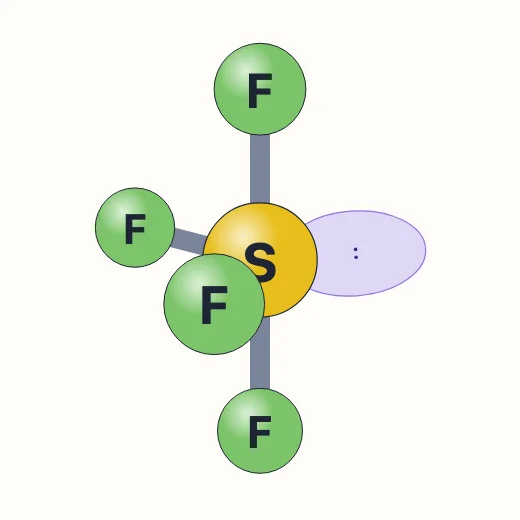
For each formula it runs the same six steps a textbook answer would, and prints them with your molecule's numbers. Here is the output for SF4:
- Count valence electrons: S (6) + 4 × F (7) = 34 electrons.
- Central atom: S. Sulfur is the least electronegative atom other than hydrogen (2.58), so it goes in the middle.
- Bond each outer atom to S (4 bonds = 8 electrons), then complete the outer atoms (4 × 6 electrons as lone pairs). That uses 32 electrons.
- 34 − 32 = 2 electrons left for S: 1 lone pair.
- Electron domains on S: 4 bonded + 1 lone = 5 (steric number). A double or triple bond still counts as one domain.
- AX4E: trigonal bipyramidal electron geometry, seesaw molecular geometry, sp3d hybridization.
How to type a formula
| You type | Read as | Formula | Result |
|---|---|---|---|
H2O | plain formula | H2O | AX2E2 · bent |
SO4 2- | charge after a space | SO42− | AX4 · tetrahedral |
SO4^2- | charge after ^ | SO42− | AX4 · tetrahedral |
NH4+ | charge straight after | NH4+ | AX4 · tetrahedral |
XeOF4 | mixed outer atoms | XeOF4 | AX5E · square pyramidal |
Element symbols are case-sensitive in the usual way (Cl, not CL). Charges can follow a space, a caret or the formula itself.
How it picks the central atom
The central atom is the least electronegative atom that is not hydrogen: S in SF4, C in SCN−, Cl in ClO4−. A few acids such as HOCl are known exceptions where H bonds to O, and the calculator puts O in the middle for those. Hydrogen is never central because it forms only one bond.
What it will not do
- More than one central atom. C2H4, CH3OH and H2O2 need VSEPR on each centre separately; the calculator says so instead of guessing a shape.
- Ionic compounds. NaCl has no VSEPR shape around sodium. Enter the polyatomic ion on its own, for example
SO4 2-for sodium sulfate. - Single atoms. A shape needs at least two atoms around a centre.
Checking homework
Work the question yourself first, then type the formula and compare line by line. If your electron count differs, the error is almost always the charge of an ion. For a drill set, use VSEPR practice.
Sources: OpenStax Chemistry 2e, §7.6 Molecular Structure and Polarity; Electronegativities of the elements (data page), Pauling scale.