The idea in one sentence
Electron pairs in the valence shell of the central atom repel each other, so they settle as far apart as possible, and the atoms bonded to them end up wherever those pairs point. Nothing else, no orbitals or quantum mechanics, is needed to predict most shapes in general chemistry.
The five rules
- Count electron domains on the central atom: each bonded atom and each lone pair is one domain.
- Multiple bonds count once. A double or triple bond to the same atom occupies one direction.
- Domains spread out as far as they can. 2 → linear, 3 → trigonal planar, 4 → tetrahedral, 5 → trigonal bipyramidal, 6 → octahedral.
- Lone pairs repel more than bonds. The order is lone pair–lone pair > lone pair–bond pair > bond pair–bond pair.
- Name the shape from the atoms only. Lone pairs shape the molecule but are not part of its name.
Worked example: methane, ammonia, water
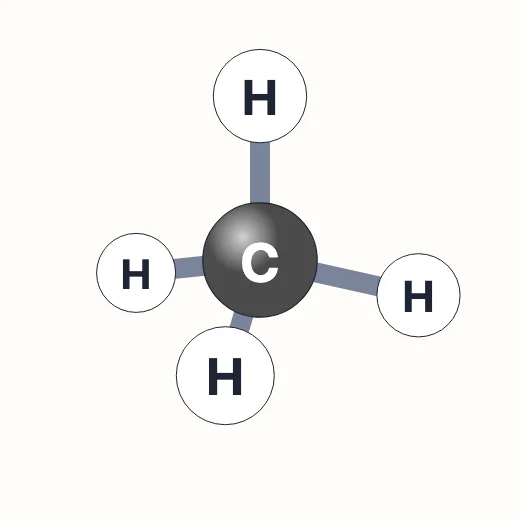
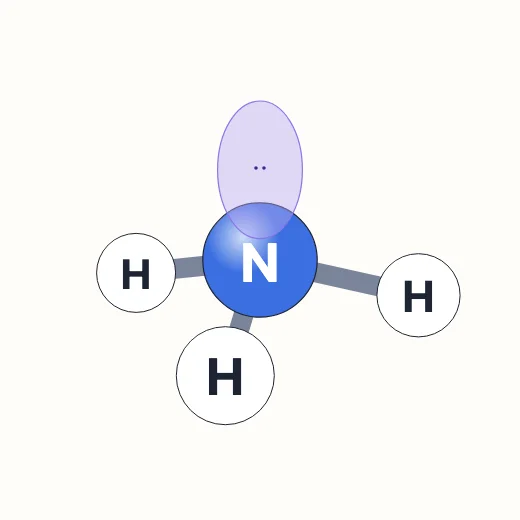
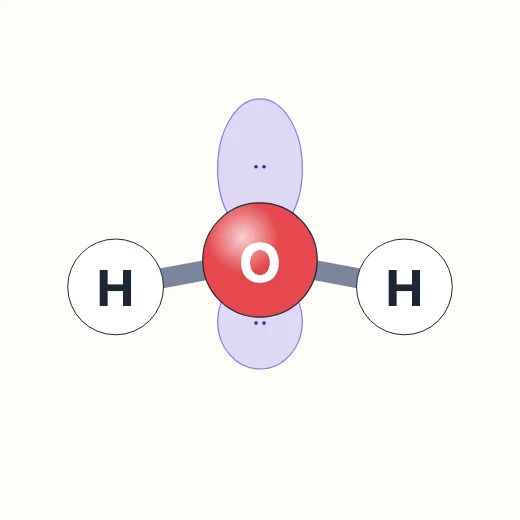
All three have four domains on the central atom, so all three start from a tetrahedron. Replacing bonds with lone pairs changes the shape and closes the angle:
| Molecule | AXE | Lone pairs | Shape | Measured angle |
|---|---|---|---|---|
| CH4 | AX4 | 0 | tetrahedral | 109.5° |
| NH3 | AX3E | 1 | trigonal pyramidal | 106.7° |
| H2O | AX2E2 | 2 | bent | 104.5° |
Why lone pairs push harder
A bonding pair is shared between two nuclei and stretched along the bond. A lone pair belongs to one nucleus only, so it sits closer to the central atom and spreads wider. It crowds its neighbours more, and the bonds next to it are pushed together. With five domains this also decides where lone pairs go: the equatorial positions, which have fewer neighbours at 90°.
Where the theory came from
Nevil Sidgwick and Herbert Powell first linked molecular shape to the number of electron pairs in 1940. Ronald Gillespie and Ronald Nyholm turned that into the set of rules taught today in 1957, and Gillespie kept refining it for decades; the model is sometimes called the Gillespie–Nyholm theory.
Where VSEPR falls short
- It gives directions, not sizes. It says NH3 is "less than 109.5°" but cannot tell you it is 106.7°, or why PH3 is only 93.5°.
- Transition metal complexes follow d-electron effects VSEPR ignores; use crystal field theory there.
- Bonding itself is not explained. For why bonds form and how orbitals mix, move on to hybridization and molecular orbital theory; the hybridization chart is the next step.
Try it on any molecule
The calculator above runs these rules on any formula and shows each step. For the full set of shapes in one table, use the VSEPR chart.
Sources: OpenStax Chemistry 2e, §7.6 Molecular Structure and Polarity.