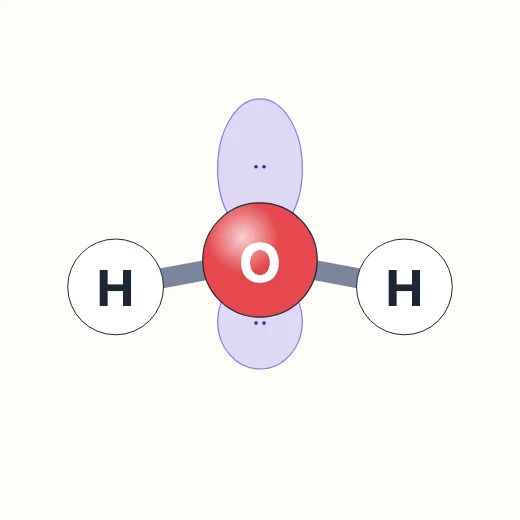
Water is the molecule most students draw first, and almost every unusual property it has traces back to the two lone pairs on oxygen. Those pairs bend the molecule, make it polar and let it form hydrogen bonds.
H2O Lewis structure, step by step
- Count valence electrons: 2 × H (1) + O (6) = 8 electrons.
- Central atom: O. Oxygen is the least electronegative atom other than hydrogen (3.44), so it goes in the middle.
- Bond each outer atom to O (2 bonds = 4 electrons), then complete the outer atoms (hydrogen needs no lone pairs). That uses 4 electrons.
- 8 − 4 = 4 electrons left for O: 2 lone pairs.
- Electron domains on O: 2 bonded + 2 lone = 4 (steric number). A double or triple bond still counts as one domain.
- AX2E2: tetrahedral electron geometry, bent molecular geometry, sp3 hybridization.
Shape, bond angle and hybridization
| Property | H2O |
|---|---|
| Valence electrons | 8 |
| Central atom | O |
| AXE | AX2E2 |
| Electron geometry | tetrahedral |
| Molecular geometry | bent |
| Bond angle | <109.5° ideal; 104.5° measured |
| Hybridization | sp3 |
| Polarity | Polar |
Four domains, only two of them bonds
Oxygen is surrounded by two O–H bonds and two lone pairs. These four domains spread toward the corners of a tetrahedron, but the molecular shape only describes where the atoms are, so what you see is a V-shaped, bent molecule.
Why 104.5° and not 109.5°
A lone pair is held by only one nucleus, so it spreads out wider than a bonding pair and pushes harder. Two lone pairs squeeze the O–H bonds from the tetrahedral 109.5° down to 104.5°, a little tighter than the 106.7° in ammonia, which has only one lone pair.
Where the polarity comes from
The O–H bonds have an electronegativity difference of 1.24, so electron density shifts toward oxygen. Because the molecule is bent, the two bond dipoles add up instead of cancelling, leaving a partly negative oxygen side and a partly positive hydrogen side.
Lone pairs make hydrogen bonds
Each water molecule can accept hydrogen bonds at its two lone pairs and donate them through its two hydrogens. That network is why water boils at 100 °C while H2S, its heavier sulfur look-alike, is a gas at room temperature.
Common mistakes
Watch out
- Drawing water as a straight line H–O–H: show the two lone pairs on oxygen, because they are what bend the molecule.
- Writing the electron geometry as bent: the electron geometry is tetrahedral (four domains); only the molecular geometry is bent.
Practice questions
Try each one before opening the answer.
How many lone pairs sit on the oxygen in H2O, and how do you know?
Two. Water has 8 valence electrons; the two O–H bonds use 4, leaving 4 electrons, or 2 pairs, on oxygen.
Which is larger, the H–O–H angle in water or the H–N–H angle in ammonia? Explain.
The H–N–H angle in ammonia (106.7°). Water has two lone pairs pressing on its bonds instead of one, so its angle shrinks further to 104.5°.
What is the hybridization of oxygen in water?
sp3. Oxygen has a steric number of 4 (two bonds plus two lone pairs), and four domains match four sp3 hybrid orbitals.
H2O compared with similar molecules
| Molecule | Valence e⁻ | AXE | Shape | Bond angle | Polarity |
|---|---|---|---|---|---|
| H2O | 8 e⁻ | AX2E2 | bent | 104.5° | polar |
| H2S | 8 e⁻ | AX2E2 | bent | 92.1° | polar |
| OF2 | 20 e⁻ | AX2E2 | bent | 103° | polar |
| NH3 | 8 e⁻ | AX3E | trigonal pyramidal | 106.7° | polar |
Where you meet it
Water is the solvent in almost every lab you'll do, and its polarity explains why table salt dissolves in it while oil floats on top.
Shape rules: OpenStax Chemistry 2e §7.6.