One lone pair or two?
"Bent" (also called angular or V-shaped) is the name for two different VSEPR classes. Both have two atoms on the centre, but the hidden lone pairs differ:
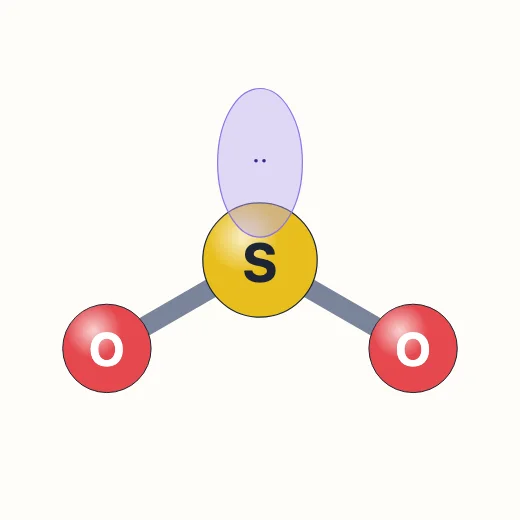
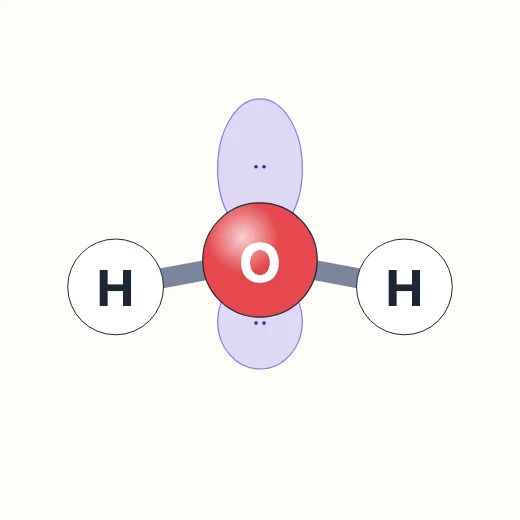
| AX2E | AX2E2 | |
|---|---|---|
| Electron geometry | trigonal planar | tetrahedral |
| Ideal angle before squeezing | 120° | 109.5° |
| Hybridization | sp2 | sp3 |
| Typical examples | SO2, O3, NO2− | H2O, H2S, OF2 |
So when a question says "bent, bond angle?", you have to know which family it is. Count the lone pairs on the central atom first.
Why the angle keeps shrinking
Lone pairs spread out more than bonding pairs, so they shove the two bonds together. One lone pair (SO2) takes the angle a little under 120°. Two lone pairs (H2O) push harder against a 109.5° start, giving 104.5°.
Going down the group the angle drops further: H2S is 92.1°. Sulfur's bonding orbitals are larger and more diffuse, the S–H bonds are longer, and the bonds behave closer to plain p orbitals at 90°. This trend is measured; VSEPR only predicts "less than 109.5°".
The odd one: NO2
Nitrogen dioxide has an odd electron count (17). A single unpaired electron repels less than a full lone pair, so the O–N–O angle opens up to 134.3°, wider than SO2. Add one electron to get nitrite, NO2−, and the angle closes to about 115°.
Always polar
A bent molecule's bond dipoles both lean the same way, toward or away from the lone-pair side, so they add rather than cancel. Every neutral bent molecule is polar; that is why water dissolves salts and why SO2 has a dipole while CO2 does not.
Every bent molecule on this site
| Molecule | Name | AXE | Central atom | Measured angle | Polarity |
|---|---|---|---|---|---|
| H2O | water | AX2E2 | O | 104.5° | polar |
| H2S | hydrogen sulfide | AX2E2 | S | 92.1° | polar |
| OF2 | oxygen difluoride | AX2E2 | O | 103° | polar |
| SCl2 | sulfur dichloride | AX2E2 | S | 103° | polar |
| NH2− | amide ion | AX2E2 | N | predicted <109.5° | ion |
| ClO2− | chlorite ion | AX2E2 | Cl | predicted <109.5° | ion |
| ClO2 | chlorine dioxide | AX2E2 | Cl | 117.6° | polar |
| HOCl | hypochlorous acid | AX2E2 | O | predicted <109.5° | polar |
| SO2 | sulfur dioxide | AX2E | S | ≈ 119° | polar |
| O3 | ozone | AX2E | O | 116.8° | polar |
| NO2− | nitrite ion | AX2E | N | ≈ 115° | ion |
| NO2 | nitrogen dioxide | AX2E | N | 134.3° | polar |
| SnCl2 | tin(II) chloride (gas) | AX2E | Sn | predicted <120° | polar |
| NOCl | nitrosyl chloride | AX2E | N | predicted <120° | polar |
Tap any formula in the tool above, or open a linked molecule page for its Lewis structure and exam questions.
Exam traps
- Giving 109.5° for water. That is the tetrahedral ideal; the measured H–O–H angle is 104.5°.
- Calling SO2 sp3. It has three domains (two bonds, one lone pair), so it is sp2.