Six equal corners
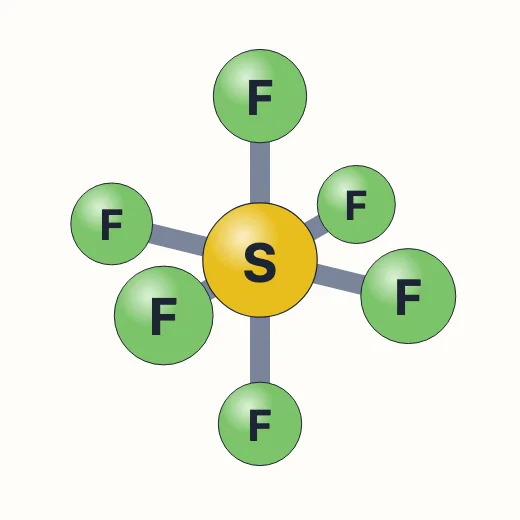
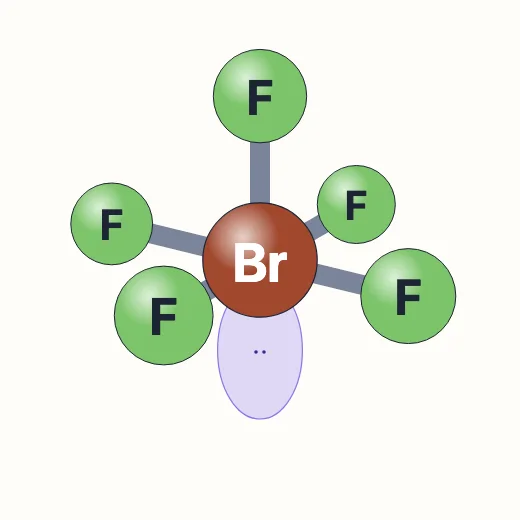
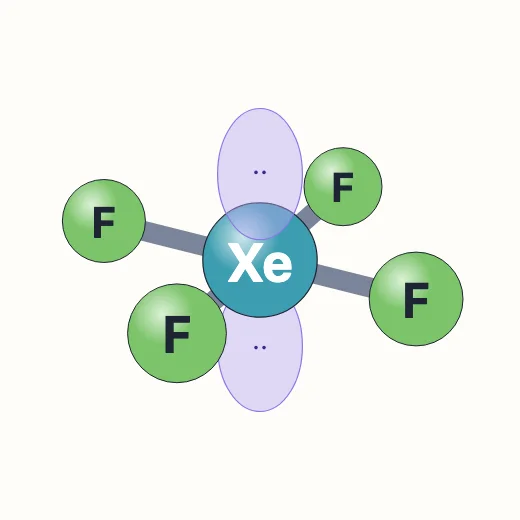
Put one atom on each end of the x, y and z axes and you have an octahedron, a shape with eight triangular faces. Every corner is equivalent: each has four neighbours at 90° and one directly opposite at 180°. That makes the octahedron simpler than the trigonal bipyramid; there is no axial vs equatorial choice.
The lone pair rules for six domains
Because all six positions are the same, the first lone pair can go anywhere. The result is square pyramidal (BrF5). The second lone pair goes directly opposite the first, 180° away, giving square planar (XeF4). Putting the two lone pairs side by side at 90° would cost far more repulsion.
SF6 in real life
SF6 is very unreactive. The six fluorine atoms crowd around sulfur and shield it from attack. Power companies use it as an insulating gas in high-voltage switchgear. It is also a very strong greenhouse gas, so its leaks are monitored.
Polarity
Six identical outer atoms cancel exactly, so SF6 is nonpolar. Every bond has an equal partner pointing the opposite way.
Every octahedral molecule on this site
| Molecule | Name | AXE | Central atom | Measured angle | Polarity |
|---|---|---|---|---|---|
| SF6 | sulfur hexafluoride | AX6 | S | predicted 90° | nonpolar |
| PF6− | hexafluorophosphate ion | AX6 | P | predicted 90° | ion |
| SiF62− | hexafluorosilicate ion | AX6 | Si | predicted 90° | ion |
Tap any formula in the tool above, or open a linked molecule page for its Lewis structure and exam questions.
Exam traps
- Listing 90° and 120°. 120° belongs to the trigonal bipyramid; octahedral angles are 90° (and 180° across).
- Calling the hybridization sp3d. Six domains need six hybrids: sp3d2.