A tetrahedron with one corner hidden
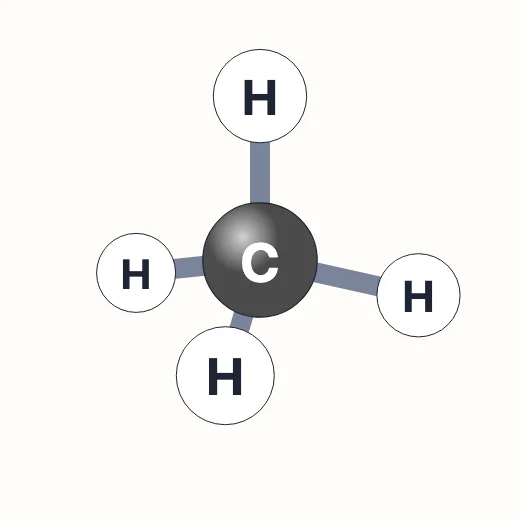
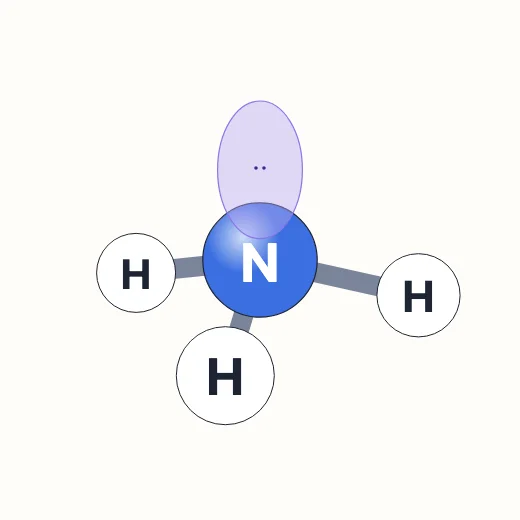
Four electron domains still point to the corners of a tetrahedron, but one of them is a lone pair. Hide it and the three remaining atoms form the base of a pyramid with the central atom as the apex. That is why the electron geometry is tetrahedral while the molecular geometry is trigonal pyramidal, and the hybridization stays sp3.
The angle depends on the atoms
VSEPR says "less than 109.5°". Measured values show how much less:
| Molecule | Measured angle | What changes |
|---|---|---|
| NH3 | 106.7° | one lone pair on a small N |
| NF3 | 102.5° | F pulls bonding electrons away from N, so the bonds take less room |
| PCl3 | 100.3° | larger P, longer bonds |
| PH3 | 93.5° | P–H bonds use nearly pure p orbitals |
The general rule: a bigger central atom, or more electronegative outer atoms, lets the lone pair win more space and the angle closes.
Trigonal pyramidal vs trigonal planar
Both have three atoms on the centre. The difference is one lone pair. BF3 has none and is flat at 120°; NH3 has one and puckers into a pyramid. If a question gives you a formula with three outer atoms, count the central atom's valence electrons before choosing.
Always polar
The lone pair sits on one face, so the three bond dipoles can't cancel. NH3, PCl3 and NF3 are all polar. In NF3 the N–F bond dipoles point away from the lone pair, which largely offsets it, so its dipole moment is small, but it is still polar.
Every trigonal pyramidal molecule on this site
| Molecule | Name | AXE | Central atom | Measured angle | Polarity |
|---|---|---|---|---|---|
| NH3 | ammonia | AX3E | N | 106.7° | polar |
| PCl3 | phosphorus trichloride | AX3E | P | 100.3° | polar |
| PH3 | phosphine | AX3E | P | 93.5° | polar |
| NF3 | nitrogen trifluoride | AX3E | N | 102.5° | polar |
| H3O+ | hydronium ion | AX3E | O | predicted <109.5° | ion |
| ClO3− | chlorate ion | AX3E | Cl | predicted <109.5° | ion |
| SO32− | sulfite ion | AX3E | S | predicted <109.5° | ion |
| XeO3 | xenon trioxide | AX3E | Xe | predicted <109.5° | polar |
| IO3− | iodate ion | AX3E | I | predicted <109.5° | ion |
| SOCl2 | thionyl chloride | AX3E | S | predicted <109.5° | polar |
| AsH3 | arsine | AX3E | As | predicted <109.5° | polar |
Tap any formula in the tool above, or open a linked molecule page for its Lewis structure and exam questions.
Exam traps
- Answering "tetrahedral" for the shape of NH3. That is the electron geometry; the shape is trigonal pyramidal.
- Using 107° for every AX3E molecule. PH3 is 93.5°.