From five domains to a T
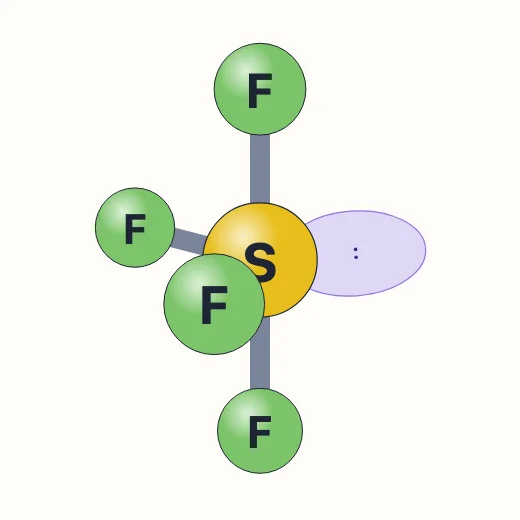
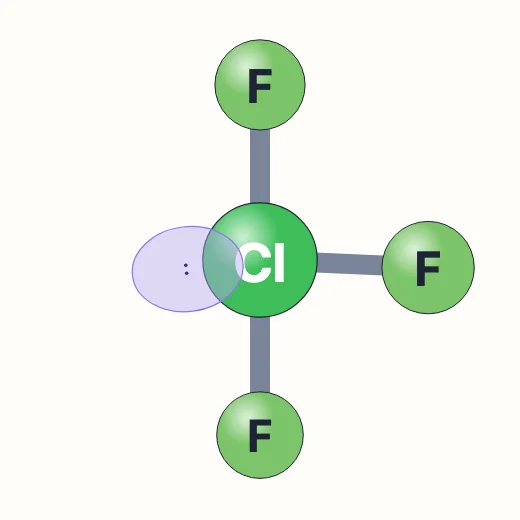
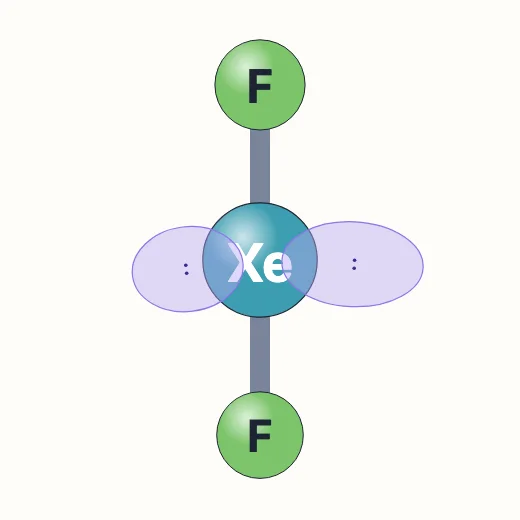
ClF3 has 28 valence electrons. Chlorine bonds three F atoms and keeps two lone pairs: five domains, so the electron geometry is trigonal bipyramidal. Both lone pairs take equatorial positions, 120° apart from each other. The remaining atoms are the two axial F atoms (the top bar of the T) and one equatorial F (the stem).
Why not trigonal planar?
Three outer atoms tempt students to say trigonal planar. But a trigonal planar molecule has no lone pairs on the centre. Chlorine has two, and they claim the equatorial space. The F–Cl–F angle between the stem and each arm is 87.5° measured, just under 90°, because the lone pairs push the axial F atoms back toward the stem.
Other T-shaped molecules
BrF3 and ICl3 follow the same pattern: a heavy halogen centre with three halogen partners. Halogen–halogen compounds like these are called interhalogens, and the T shape is their signature for the XY3 type.
Polarity
T-shaped molecules are polar. The stem's dipole is not balanced by anything on the opposite side, because that side holds the lone pairs.
Every t-shaped molecule on this site
| Molecule | Name | AXE | Central atom | Measured angle | Polarity |
|---|---|---|---|---|---|
| ClF3 | chlorine trifluoride | AX3E2 | Cl | 87.5° | polar |
| BrF3 | bromine trifluoride | AX3E2 | Br | predicted <90° | polar |
| ICl3 | iodine trichloride | AX3E2 | I | predicted <90° | polar |
Tap any formula in the tool above, or open a linked molecule page for its Lewis structure and exam questions.
Exam traps
- Answering "trigonal planar" for ClF3. Count the lone pairs: two.
- Answering "trigonal pyramidal". That needs four domains; ClF3 has five.