Where the lone pair goes
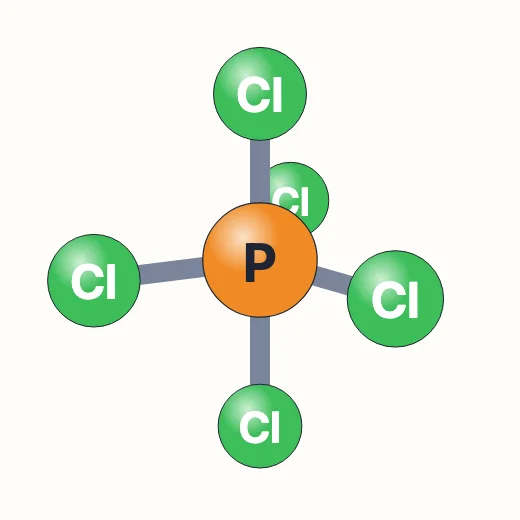
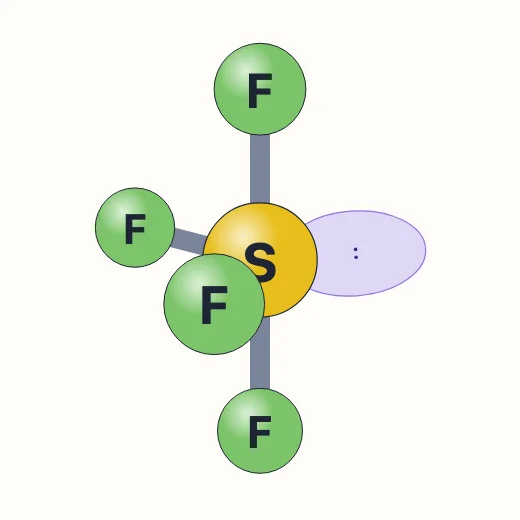
Start from the five positions of a trigonal bipyramid and remove one atom for the lone pair. There are two options:
- Axial lone pair: three neighbours at 90°. The leftover atoms would form a trigonal pyramid.
- Equatorial lone pair: only two neighbours at 90°. The leftover atoms form a seesaw.
Fewer 90° clashes wins, so the lone pair is equatorial. Turn the 3D model so the two axial F atoms run left to right: that's the plank, and the two equatorial F atoms are the legs.
Measured angles in SF4
The lone pair pushes everything away from itself. The axial F–S–F angle closes from 180° to 173.1°, bending the plank slightly, and the equatorial F–S–F angle closes from 120° to 101.6°. Both numbers come from gas-phase measurements (NIST CCCBDB).
Other seesaw molecules
SeF4 and TeCl4 use the same pattern one row down in group 16, and the cation IF4+ has it too. The rule that spots them: a central atom with 5 electron domains and exactly 4 outer atoms.
Polarity
The lone pair leaves one side empty, so the S–F dipoles do not cancel. SF4 is polar.
Every seesaw molecule on this site
| Molecule | Name | AXE | Central atom | Measured angle | Polarity |
|---|---|---|---|---|---|
| SF4 | sulfur tetrafluoride | AX4E | S | F(ax)–S–F(ax) 173.1°, F(eq)–S–F(eq) 101.6° | polar |
| SeF4 | selenium tetrafluoride | AX4E | Se | predicted <90°, <120° | polar |
| TeCl4 | tellurium tetrachloride | AX4E | Te | predicted <90°, <120° | polar |
| IF4+ | tetrafluoroiodonium ion | AX4E | I | predicted <90°, <120° | ion |
Tap any formula in the tool above, or open a linked molecule page for its Lewis structure and exam questions.
Exam traps
- Drawing the lone pair axial and calling SF4 trigonal pyramidal.
- Calling SF4 tetrahedral because it has four atoms. Sulfur has a fifth domain, the lone pair.