Three kinds of answer
- Exact ideal. No lone pairs on the centre and identical outer atoms: BF3 is 120°, CH4 109.5°, SF6 90°.
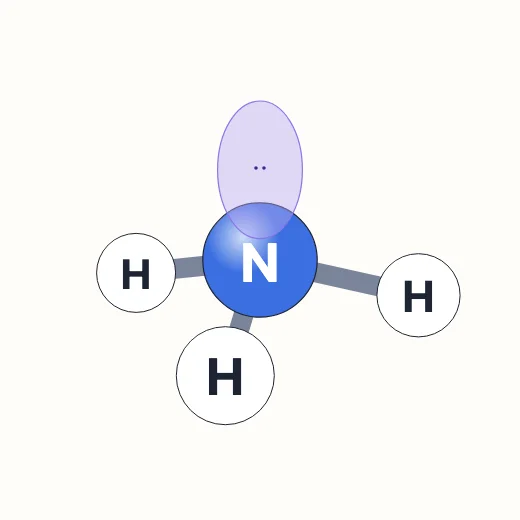
- "Less than" the ideal. Lone pairs present: NH3 is less than 109.5°. Most exams accept that wording, or "about 107°".
- Measured. For 17 molecules the calculator also gives the experimental angle, from the NIST CCCBDB.
Ranking angles
A common question asks you to put molecules in order of bond angle. Work it in two passes:
- Group by electron geometry. More domains means a smaller ideal: 180° > 120° > 109.5° > 90°.
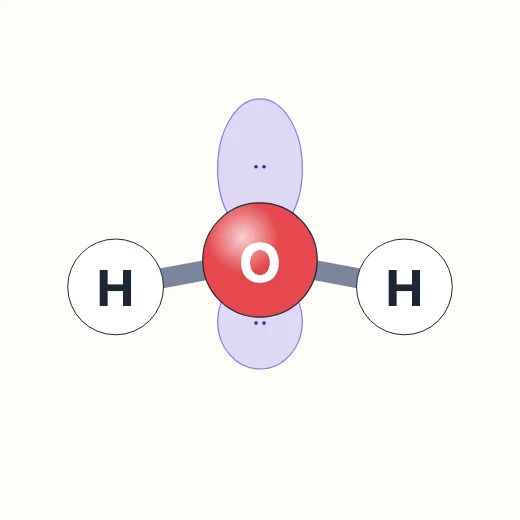
- Within a group, more lone pairs means smaller. CH4 109.5° > NH3 106.7° > H2O 104.5°.
For example, BF3 (three domains, 120°) comes before NF3 (four domains, measured 102.5°), even though both have three fluorines.
When the rules are not enough
VSEPR does not predict how much a lone pair squeezes, and two molecules with the same AXE can differ by more than 10°. PH3 (93.5°) and NH3 (106.7°) are both trigonal pyramidal. The bond angle chart explains the size and electronegativity effects behind that gap.
See the angle in 3D
Tap Open 3D in the result to turn the molecule and read the angle labels on the model. The lone pairs are drawn as translucent lobes so you can see what is doing the squeezing.
Sources: NIST Computational Chemistry Comparison and Benchmark Database, experimental geometries; OpenStax Chemistry 2e, §7.6 Molecular Structure and Polarity.