The ideal angles
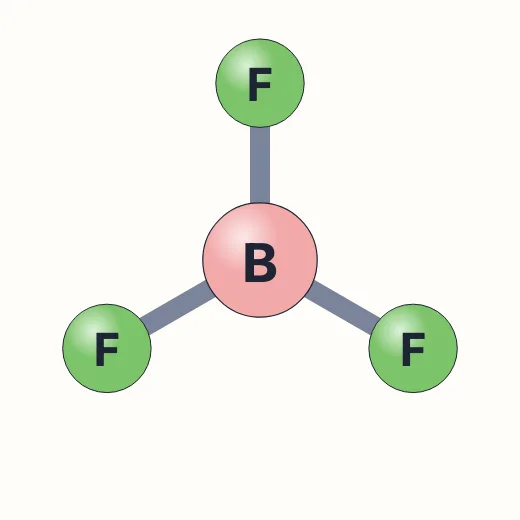
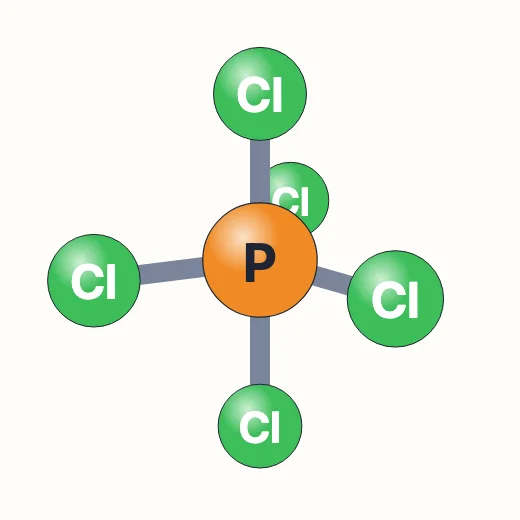
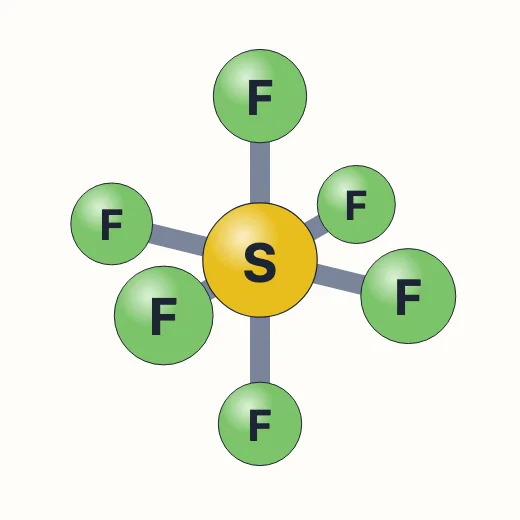
Ideal angles come from geometry alone: the angle that keeps the domains farthest apart. 180° for two domains, 120° for three, 109.5° for four (the exact tetrahedral angle is 109.47°), 90° and 120° for five, 90° for six. They hold exactly only when every domain is the same kind of bond to the same kind of atom.
Predict an angle in three steps
- Find the electron geometry from the domain count. That sets the ideal.
- If the central atom has no lone pairs and all outer atoms match, the angle is the ideal.
- Each lone pair squeezes the bond angles a little below the ideal. Write "less than 109.5°" or "about 107°", unless you know the measured value.
Why real angles drift
Lone pairs are the reason most textbooks give, but the measured data show two more:
| Change (measured angles) | Shape | What changed |
|---|---|---|
| NH3 106.7° → PH3 93.5° | trigonal pyramidal | larger central atom |
| H2O 104.5° → H2S 92.1° | bent | larger central atom |
| NH3 106.7° → NF3 102.5° | trigonal pyramidal | more electronegative outer atoms |
| NO2− ≈ 115° → NO2 134.3° | bent | lone pair replaced by one electron |
- Bigger central atom, smaller angle. Going down a group, the bonds get longer and the bonding pairs sit farther apart, so the lone pairs win more room. PH3 and H2S are close to 90°.
- More electronegative outer atoms, smaller angle. Fluorine pulls the bonding pairs away from nitrogen, so in NF3 they repel each other less than in NH3.
- One electron instead of a pair, wider angle. The radical NO2 has a single unpaired electron on N. It pushes far less than the lone pair in NO2−, and the angle opens past 120°.
Angles in five-domain shapes
Five-domain shapes have two kinds of angle. In SF4 the measured axial F–S–F angle is 173.1° instead of 180°, and the equatorial one is 101.6° instead of 120°: both bend away from the lone pair. In ClF3 the axial F–Cl–F bonds fold to 87.5° from the equatorial one, a little under the ideal 90°.
Common slip
Writing 109.5° for water because its electron geometry is tetrahedral. 109.5° is the angle between domains; the angle between the two O–H bonds is 104.5°.
Sources: NIST Computational Chemistry Comparison and Benchmark Database, experimental geometries; OpenStax Chemistry 2e, §7.6 Molecular Structure and Polarity.