Two routes to a straight line
A linear molecule has its central atom and both outer atoms on one axis. VSEPR reaches that shape from two very different starting points:
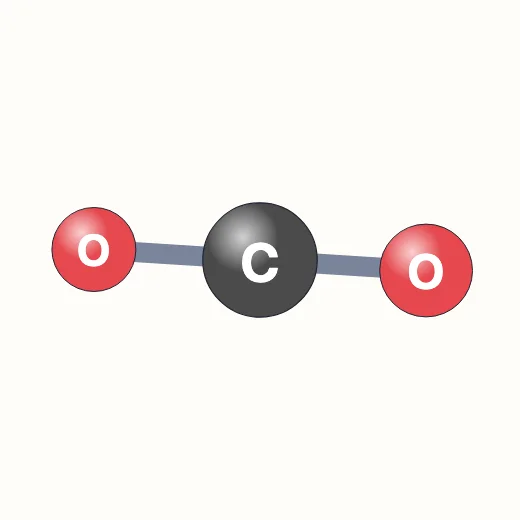
- AX2: only two electron domains. The farthest apart two things can get is opposite sides, so the angle is exactly 180° and the hybridization is sp. Double and triple bonds count as one domain each, which is why CO2 (two C=O) and HCN (C–H plus C≡N) both land here.
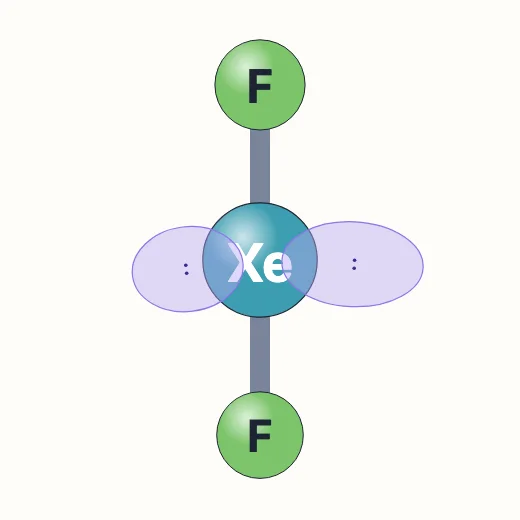
- AX2E3: five domains in a trigonal bipyramid. The three lone pairs take the three equatorial seats, 120° apart, where they have the most room. The two bonded atoms are left on the axial line, so the molecule is still 180°.
Telling the two apart on a test
Count the lone pairs on the central atom. Zero means AX2 and sp; three means AX2E3, a trigonal bipyramidal electron geometry and sp3d. The molecular shape answer is "linear" for both, but the electron geometry and hybridization answers differ, and that is where marks are lost.
A quick check: xenon, iodine and krypton centres with two outer halogens are almost always AX2E3. Carbon and beryllium centres with two partners are AX2.
Polarity of linear molecules
With identical outer atoms the two bond dipoles point in opposite directions and cancel, so CO2, CS2 and XeF2 are nonpolar even though each bond is polar. Put two different atoms on the ends and the cancellation fails: HCN is polar, and so is N2O (N–N–O).
Every linear molecule on this site
| Molecule | Name | AXE | Central atom | Measured angle | Polarity |
|---|---|---|---|---|---|
| CO2 | carbon dioxide | AX2 | C | predicted 180° | nonpolar |
| BeCl2 | beryllium chloride | AX2 | Be | predicted 180° | nonpolar |
| HCN | hydrogen cyanide | AX2 | C | predicted 180° | polar |
| CS2 | carbon disulfide | AX2 | C | predicted 180° | nonpolar |
| N2O | nitrous oxide | AX2 | N | predicted 180° | polar |
| N3− | azide ion | AX2 | N | predicted 180° | ion |
| NO2+ | nitronium ion | AX2 | N | predicted 180° | ion |
| XeF2 | xenon difluoride | AX2E3 | Xe | predicted 180° | nonpolar |
| I3− | triiodide ion | AX2E3 | I | predicted 180° | ion |
| ICl2− | dichloroiodate ion | AX2E3 | I | predicted 180° | ion |
| KrF2 | krypton difluoride | AX2E3 | Kr | predicted 180° | nonpolar |
Tap any formula in the tool above, or open a linked molecule page for its Lewis structure and exam questions.
Exam traps
- Calling XeF2 "trigonal bipyramidal". That is its electron geometry; the shape you name is linear.
- Counting the C=O double bonds in CO2 as two domains each. Each multiple bond is one domain.