Why 109.5° and not 90°
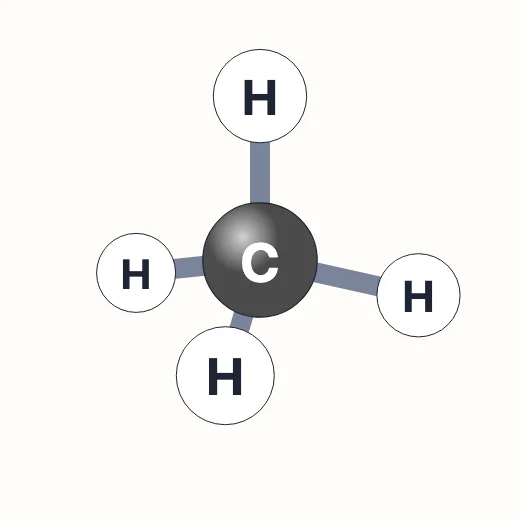
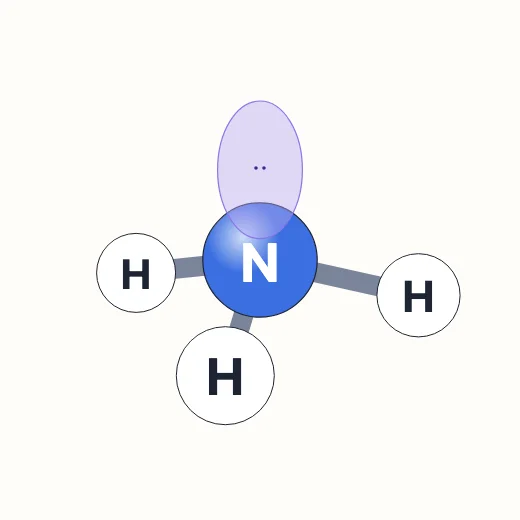
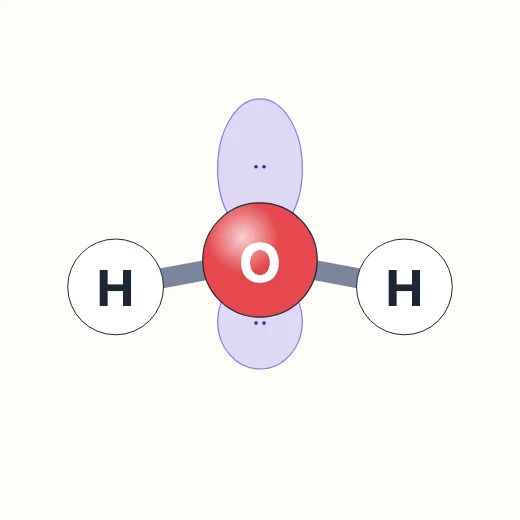
Drawn flat on paper, four bonds look like a cross at 90°. In three dimensions they can do better. The arrangement that keeps four equal domains farthest apart puts them at alternate corners of a cube, and the angle between any two is cos−1(−1/3) = 109.47°, rounded to 109.5°.
Every pair of bonds makes that same angle, so all six H–C–H angles in methane are equal.
Tetrahedral is the parent of three shapes
Four electron domains always give a tetrahedral electron geometry. With 0, 1 or 2 lone pairs you get tetrahedral, trigonal pyramidal and bent shapes. This family covers most of organic chemistry: every sp3 carbon, the nitrogen in amines and the oxygen in water and alcohols.
Ions and expanded examples
The ammonium ion NH4+ and the sulfate ion SO42− are both tetrahedral. Sulfate is often drawn with two S=O double bonds to lower formal charges; VSEPR does not care, because each S–O link is one domain either way. The Lewis structure generator shows both drawings.
When tetrahedral is polar
Four identical outer atoms (CH4, CCl4, CF4) cancel perfectly and are nonpolar. Mix them and the symmetry breaks: CH2Cl2 and CHCl3 are polar even though the shape is still tetrahedral.
Every tetrahedral molecule on this site
| Molecule | Name | AXE | Central atom | Measured angle | Polarity |
|---|---|---|---|---|---|
| CH4 | methane | AX4 | C | 109.5° | nonpolar |
| CCl4 | carbon tetrachloride | AX4 | C | predicted 109.5° | nonpolar |
| CF4 | carbon tetrafluoride | AX4 | C | predicted 109.5° | nonpolar |
| NH4+ | ammonium ion | AX4 | N | predicted 109.5° | ion |
| SiH4 | silane | AX4 | Si | predicted 109.5° | nonpolar |
| SO42− | sulfate ion | AX4 | S | predicted 109.5° | ion |
| PO43− | phosphate ion | AX4 | P | predicted 109.5° | ion |
| ClO4− | perchlorate ion | AX4 | Cl | predicted 109.5° | ion |
| CH2Cl2 | dichloromethane | AX4 | C | predicted 109.5° | polar |
| CHCl3 | chloroform | AX4 | C | predicted 109.5° | polar |
| CH3Cl | chloromethane | AX4 | C | predicted 109.5° | polar |
| XeO4 | xenon tetroxide | AX4 | Xe | predicted 109.5° | nonpolar |
| POCl3 | phosphoryl chloride | AX4 | P | predicted 109.5° | polar |
| SO2Cl2 | sulfuryl chloride | AX4 | S | predicted 109.5° | polar |
| AlCl4− | tetrachloroaluminate ion | AX4 | Al | predicted 109.5° | ion |
Tap any formula in the tool above, or open a linked molecule page for its Lewis structure and exam questions.
Exam traps
- Saying CH2Cl2 is nonpolar "because it is tetrahedral". Different outer atoms make it polar.
- Writing 90° for tetrahedral because the Lewis drawing is flat.