Two lone pairs, opposite each other
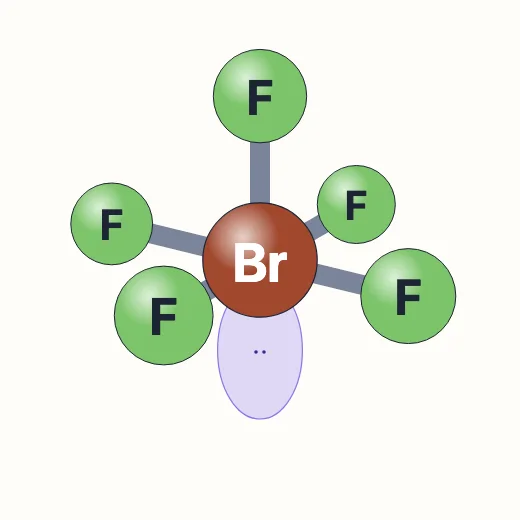
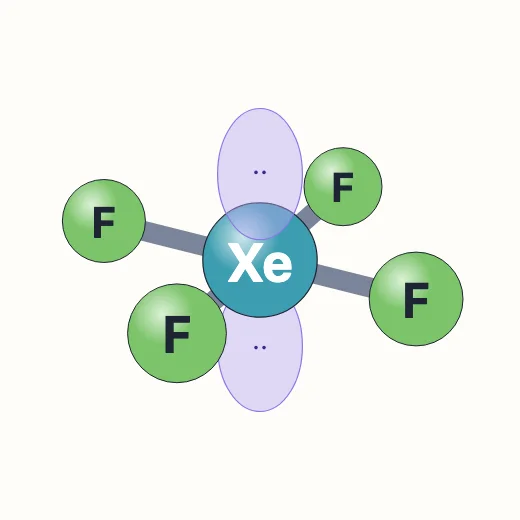
XeF4 has 36 valence electrons. Xenon bonds four F atoms and keeps two lone pairs: six domains, octahedral electron geometry. The two lone pairs go on opposite sides (180° apart) so they don't clash at 90°. What remains is four F atoms in one plane, each 90° from its neighbours.
Because the lone pairs pull equally in opposite directions, the square is not distorted: the angles stay at 90°, unlike most shapes with lone pairs.
Square planar vs tetrahedral
Four outer atoms can make either shape. Carbon in CH4 has no lone pairs and is tetrahedral. Xenon in XeF4 has two lone pairs and is square planar. Always count the central atom's electrons first.
Square planar is also common in transition-metal complexes (Pt(NH3)2Cl2, cisplatin), but there the reason is d-electron count, not VSEPR lone pairs.
Polarity
With four identical atoms the opposite bonds cancel, and the two lone pairs cancel each other. XeF4 is nonpolar, which surprises people who expect "lone pairs = polar".
Every square planar molecule on this site
| Molecule | Name | AXE | Central atom | Measured angle | Polarity |
|---|---|---|---|---|---|
| XeF4 | xenon tetrafluoride | AX4E2 | Xe | predicted 90° | nonpolar |
| ICl4− | tetrachloroiodate ion | AX4E2 | I | predicted 90° | ion |
| BrF4− | tetrafluorobromate ion | AX4E2 | Br | predicted 90° | ion |
Tap any formula in the tool above, or open a linked molecule page for its Lewis structure and exam questions.
Exam traps
- Calling XeF4 tetrahedral because it has four atoms. Xenon has two lone pairs too.
- Saying XeF4 is polar because it has lone pairs. Opposite lone pairs cancel.