Carbon dioxide is the gas you breathe out and the one plants pull from the air. Its Lewis structure is quick to draw, but it is the classic case of a molecule full of polar bonds that ends up nonpolar overall.
CO2 Lewis structure, step by step
- Count valence electrons: C (4) + 2 × O (6) = 16 electrons.
- Central atom: C. Carbon is the least electronegative atom other than hydrogen (2.55), so it goes in the middle.
- Bond each outer atom to C (2 bonds = 4 electrons), then complete the outer atoms (2 × 6 electrons as lone pairs). That uses 16 electrons.
- 16 − 16 = 0 electrons left for C, so it has no lone pairs.
- That leaves C with only 4 electrons, short of an octet. Move two lone pairs from the outer atoms into the bonds: two C=O double bonds. Now C has 8.
- Electron domains on C: 2 bonded + 0 lone = 2 (steric number). A double or triple bond still counts as one domain.
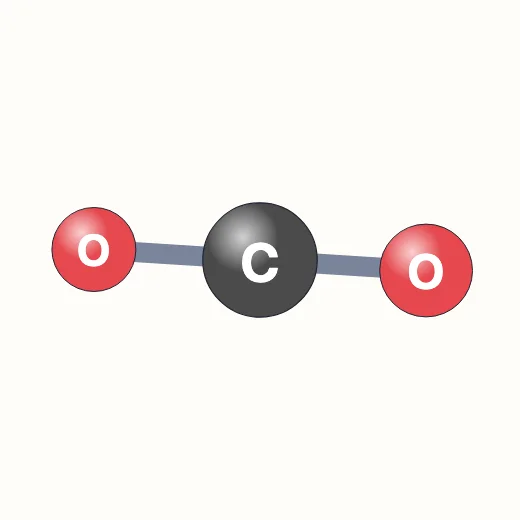
- AX2: linear electron geometry, linear molecular geometry, sp hybridization.
Shape, bond angle and hybridization
| Property | CO2 |
|---|---|
| Valence electrons | 16 |
| Central atom | C |
| AXE | AX2 |
| Electron geometry | linear |
| Molecular geometry | linear |
| Bond angle | 180° |
| Hybridization | sp |
| Polarity | Nonpolar |
Why two double bonds, not single bonds
If you join each oxygen to carbon with a single bond and fill the oxygens, all 16 electrons are used and carbon has only 4 electrons around it. Moving one lone pair from each oxygen into a shared pair gives O=C=O, where every atom has an octet and every formal charge is zero.
Four bonds, but only two domains
Carbon has four bonding pairs in total, packed into just two regions of electron density, one toward each oxygen. VSEPR counts regions, not bonds, so the steric number is 2 and the two regions point in opposite directions at 180°.
Polar bonds, nonpolar molecule
Oxygen is more electronegative than carbon by 0.89, so each C=O bond pulls electrons toward its oxygen. The two pulls are equal in size and exactly opposite, so they cancel and the molecule has no net dipole. With only weak London forces between molecules, solid CO2 (dry ice) turns straight into gas at about −78 °C.
Compare it with SO2
Sulfur dioxide follows the same AB2 formula pattern, but its two extra valence electrons become a lone pair on sulfur. That lone pair bends SO2 and makes it polar, while carbon has none, so CO2 stays straight.
Common mistakes
Watch out
- Drawing lone pairs on the carbon: carbon uses all four of its valence electrons in the two double bonds, so the central atom has zero lone pairs.
- Calling CO2 polar because C=O bonds are polar: always check the shape too, since a linear molecule with identical ends cancels its bond dipoles.
Practice questions
Try each one before opening the answer.
How many bonding pairs and lone pairs does CO2 have altogether?
4 bonding pairs (two in each double bond) and 4 lone pairs (two on each oxygen). That is 8 pairs, which accounts for all 16 valence electrons.
What is the hybridization of carbon in CO2, and how many pi bonds are there?
Carbon is sp because it has two electron domains. Each C=O double bond is one sigma plus one pi bond, so the molecule has 2 sigma and 2 pi bonds.
CO2 and H2O both have the pattern AB2. Why is one linear and the other bent?
Carbon in CO2 has no lone pairs, so its two domains sit at 180°. Oxygen in H2O has two lone pairs, giving four domains, which forces the two O–H bonds into a bent shape.
CO2 compared with similar molecules
| Molecule | Valence e⁻ | AXE | Shape | Bond angle | Polarity |
|---|---|---|---|---|---|
| CO2 | 16 e⁻ | AX2 | linear | 180° | nonpolar |
| CS2 | 16 e⁻ | AX2 | linear | 180° | nonpolar |
| SO2 | 18 e⁻ | AX2E | bent | ≈ 119° | polar |
| N2O | 16 e⁻ | AX2 | linear | 180° | polar |
Where you meet it
You meet CO2 in the limewater test in school labs, in fizzy drinks, in dry ice and in every discussion of the greenhouse effect.
Structure data: OpenStax Chemistry 2e, §7.6 Molecular Structure and Polarity. Shape rules: OpenStax Chemistry 2e §7.6.