What counts as an electron domain
An electron domain is any region around the central atom where electrons gather. Each of these counts as one:
- a single bond, a double bond or a triple bond to one atom
- a lone pair on the central atom
- a single unpaired electron, in radicals such as NO2
| Molecule | Atoms bonded | Lone pairs | Domains | Electron geometry | Molecular geometry |
|---|---|---|---|---|---|
| CO2 | 2 | 0 | 2 | linear | linear |
| SO2 | 2 | 1 | 3 | trigonal planar | bent |
| NO2 | 2 | 0 + 1 unpaired e⁻ | 3 | trigonal planar | bent |
| H2O | 2 | 2 | 4 | tetrahedral | bent |
| NH3 | 3 | 1 | 4 | tetrahedral | trigonal pyramidal |
| PCl5 | 5 | 0 | 5 | trigonal bipyramidal | trigonal bipyramidal |
| SF4 | 4 | 1 | 5 | trigonal bipyramidal | seesaw |
| XeF4 | 4 | 2 | 6 | octahedral | square planar |
The electron geometry depends only on the number in the Domains column. Whether a domain is a bond or a lone pair decides the molecular shape on top of it.
The five electron geometries
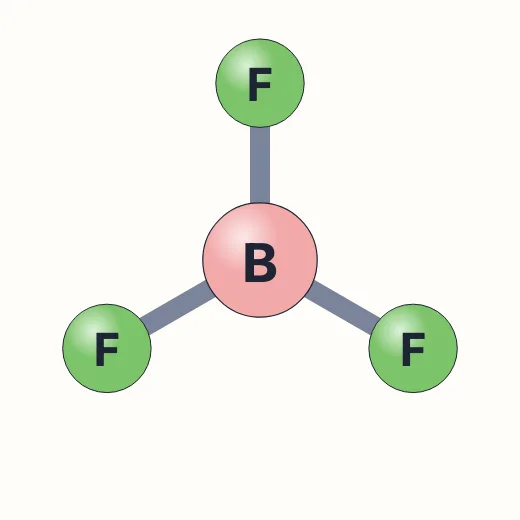
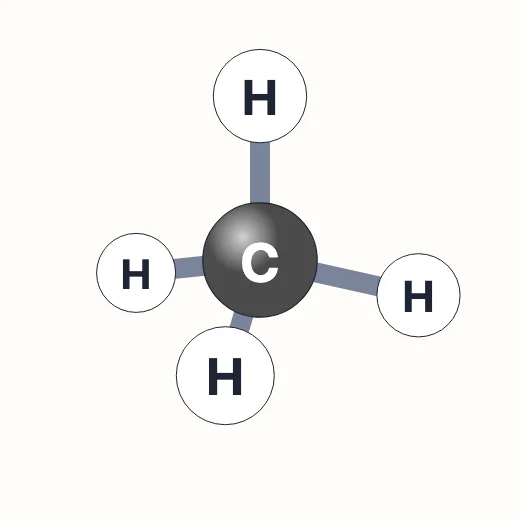
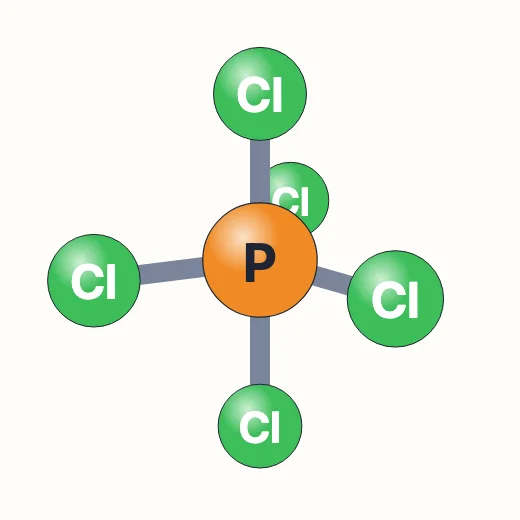
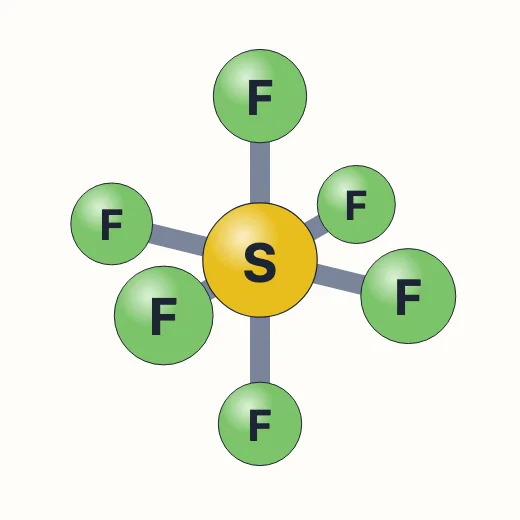
Two domains are the simple case: they sit on opposite sides at 180°, a linear electron geometry. From there each extra domain needs a new arrangement that keeps every pair of domains as far apart as possible. Seven domains, as in IF7, give a pentagonal bipyramid; that case sits outside most general chemistry courses, so the chart stops at six.
Where the lone pairs go
- Tetrahedral: all four positions are equal, so one lone pair (NH3) or two (H2O) can sit anywhere; the result is the same shape.
- Trigonal bipyramidal: the three equatorial positions have only two neighbours at 90°, the two axial ones have three. Lone pairs go equatorial first: SF4 (seesaw), ClF3 (T-shaped), XeF2 (linear).
- Octahedral: the first lone pair goes anywhere (BrF5, square pyramidal); the second goes directly opposite it (XeF4, square planar), as far as possible from the first.
Electron geometry in three steps
- Draw the Lewis structure, or let the Lewis structure generator draw it.
- On the central atom, count bonded atoms and lone pairs. Add them.
- Read the electron geometry off that total: 2 linear, 3 trigonal planar, 4 tetrahedral, 5 trigonal bipyramidal, 6 octahedral.
The question asks which one?
"Electron geometry", "electron domain geometry" and "electron pair geometry" are the same thing. "Molecular geometry" and "molecular shape" are the other answer. For water that is tetrahedral versus bent; see the side-by-side pairs in electron vs molecular geometry.
Sources: OpenStax Chemistry 2e, §7.6 Molecular Structure and Polarity.