Flat, with three equal gaps
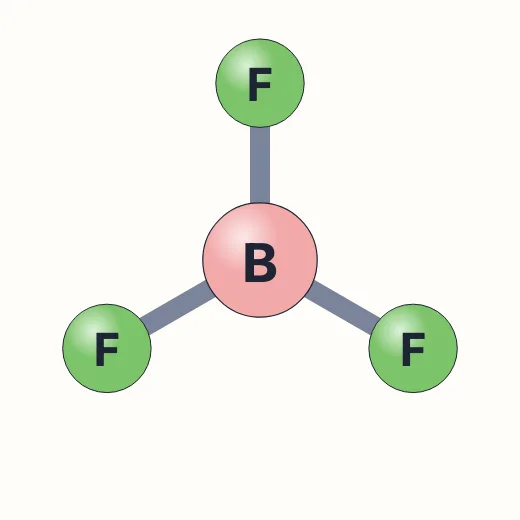
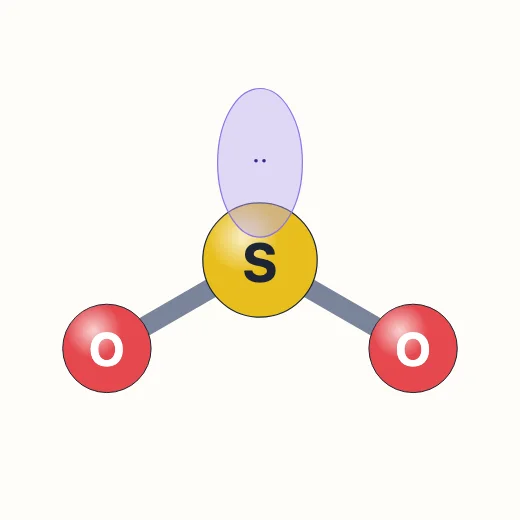
Three domains spread out as far as they can in a plane: 360° ÷ 3 = 120°. The central atom uses sp2 hybrids, leaving one unhybridized p orbital sticking straight up and down. That spare p orbital is where the π bond goes in molecules like SO3, NO3− and CH2O.
Boron: planar with only six electrons
BF3, BCl3 and BH3 are trigonal planar because boron has just three valence electrons to share. The centre ends up with six electrons, an incomplete octet, and an empty p orbital. That empty orbital is why BF3 grabs a lone pair from NH3 to make F3B–NH3, a classic Lewis acid–base reaction. After it accepts the pair, boron has four domains and turns tetrahedral.
Resonance keeps the angles equal
In NO3− and CO32− any single drawing shows one double bond and two single bonds. Real bond lengths are all the same, because the double bond is spread over three positions (three resonance structures). Equal bonds give an exact 120° triangle. When the outer atoms differ, as in formaldehyde, the angles drift: H–C–H in CH2O is about 116.5°, because the C=O double bond's extra electron density pushes the two C–H bonds closer.
Polar or not?
Three identical outer atoms make the bond dipoles cancel, so BF3 and SO3 are nonpolar. Change one outer atom (CH2O, COCl2) and the molecule becomes polar.
Every trigonal planar molecule on this site
| Molecule | Name | AXE | Central atom | Measured angle | Polarity |
|---|---|---|---|---|---|
| BF3 | boron trifluoride | AX3 | B | predicted 120° | nonpolar |
| BCl3 | boron trichloride | AX3 | B | predicted 120° | nonpolar |
| BH3 | borane | AX3 | B | predicted 120° | nonpolar |
| SO3 | sulfur trioxide | AX3 | S | predicted 120° | nonpolar |
| NO3− | nitrate ion | AX3 | N | predicted 120° | ion |
| CO32− | carbonate ion | AX3 | C | predicted 120° | ion |
| CH2O | formaldehyde | AX3 | C | H–C–H ≈ 116.5° | polar |
| COCl2 | phosgene | AX3 | C | predicted 120° | polar |
Tap any formula in the tool above, or open a linked molecule page for its Lewis structure and exam questions.
Exam traps
- Making NH3 trigonal planar. Nitrogen has a lone pair, so it is trigonal pyramidal.
- Forcing an octet on boron in BF3 with a B=F double bond. The accepted structure has three single bonds and six electrons on boron.