An octahedron missing one corner
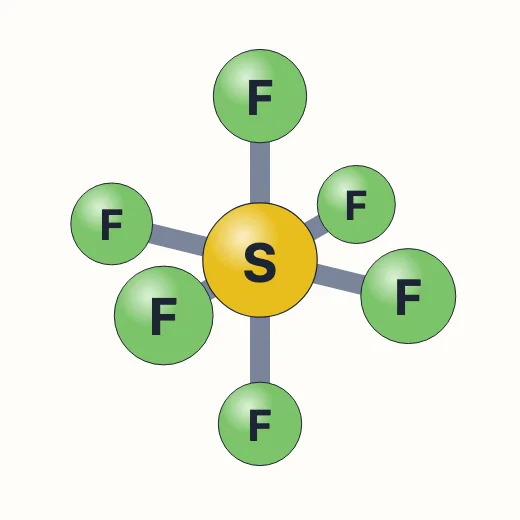
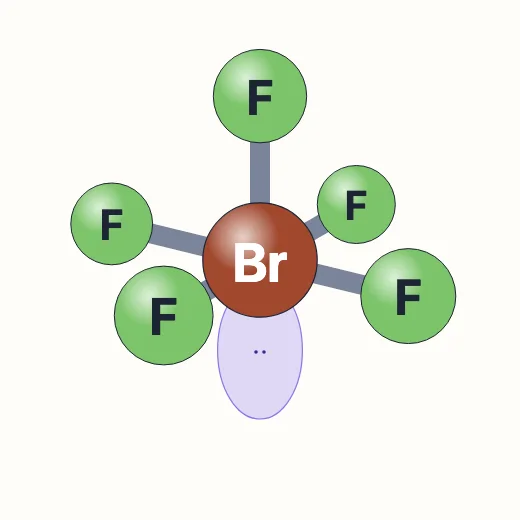
Six domains point to the corners of an octahedron. Make one of them a lone pair and the remaining five atoms form a pyramid with a square base. The central atom sits slightly below the plane of the four base atoms, because the lone pair underneath pushes them up and away. That is why the angles are listed as "less than 90°".
Square pyramidal vs trigonal bipyramidal
Both have five atoms, and students often mix them up. Count domains: PCl5 has five (no lone pair) and is trigonal bipyramidal. BrF5 has six (one lone pair) and is square pyramidal. Bromine has 7 valence electrons; five go to bonds and two stay as the lone pair.
Examples
Halogen pentafluorides (BrF5, IF5) and the xenon oxyfluoride XeOF4 are the common ones. In XeOF4 the oxygen takes the apex position opposite the lone pair.
Polarity
The lone pair on one side and the apex atom on the other are not equal partners, so square pyramidal molecules are polar.
Every square pyramidal molecule on this site
| Molecule | Name | AXE | Central atom | Measured angle | Polarity |
|---|---|---|---|---|---|
| BrF5 | bromine pentafluoride | AX5E | Br | predicted <90° | polar |
| IF5 | iodine pentafluoride | AX5E | I | predicted <90° | polar |
| XeOF4 | xenon oxytetrafluoride | AX5E | Xe | predicted <90° | polar |
Tap any formula in the tool above, or open a linked molecule page for its Lewis structure and exam questions.
Exam traps
- Calling BrF5 trigonal bipyramidal because it has five atoms. It has six domains.
- Calling the hybridization sp3d. Six domains give sp3d2.