Methane is the simplest organic molecule and the main component of natural gas. With four identical bonds and no lone pairs, it is the reference shape every other four-domain molecule is measured against.
CH4 Lewis structure, step by step
- Count valence electrons: C (4) + 4 × H (1) = 8 electrons.
- Central atom: C. Carbon is the least electronegative atom other than hydrogen (2.55), so it goes in the middle.
- Bond each outer atom to C (4 bonds = 8 electrons), then complete the outer atoms (hydrogen needs no lone pairs). That uses 8 electrons.
- 8 − 8 = 0 electrons left for C, so it has no lone pairs.
- Electron domains on C: 4 bonded + 0 lone = 4 (steric number). A double or triple bond still counts as one domain.
- AX4: tetrahedral electron geometry, tetrahedral molecular geometry, sp3 hybridization.
Shape, bond angle and hybridization
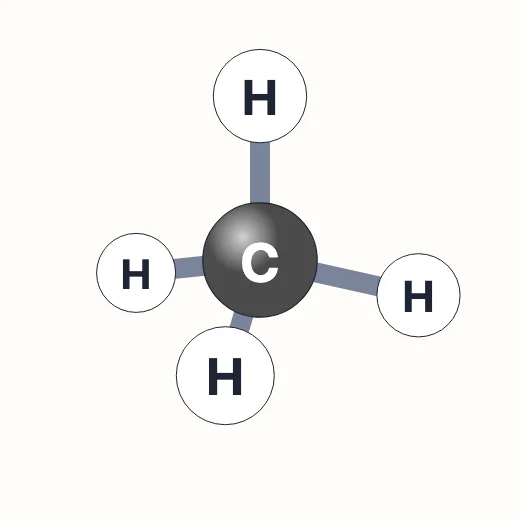
| Property | CH4 |
|---|---|
| Valence electrons | 8 |
| Central atom | C |
| AXE | AX4 |
| Electron geometry | tetrahedral |
| Molecular geometry | tetrahedral |
| Bond angle | 109.5° ideal; 109.5° measured |
| Hybridization | sp3 |
| Polarity | Nonpolar |
Every electron is in a bond
Carbon brings 4 valence electrons and each hydrogen brings 1, for 8 in total. Four C–H bonds use all of them, so carbon has a full octet, no lone pairs and a formal charge of zero.
Why it is not a flat square
A flat drawing on paper makes CH4 look like a cross with 90° angles. In three dimensions, four equal domains get farther apart in a tetrahedron, where every H–C–H angle is 109.5°. Wedge and dash bonds show this on paper.
Why it is nonpolar
The C–H electronegativity difference is only 0.35, so each bond is close to nonpolar. Even those small dipoles cancel exactly in a symmetric tetrahedron, leaving methane with no net dipole and only weak London forces between molecules.
Where sp3 comes from
Carbon mixes one 2s and three 2p orbitals into four equal sp3 orbitals, and each overlaps with a hydrogen 1s orbital. This is the same model used for every saturated carbon in organic chemistry.
Common mistakes
Watch out
- Saying the bond angle is 90° because the flat drawing looks like a cross: the real molecule is 3D and every angle is 109.5°.
Practice questions
Try each one before opening the answer.
How many sigma bonds and lone pairs does CH4 have?
Four sigma bonds, one for each C–H, and zero lone pairs.
If one hydrogen in CH4 is replaced by chlorine, is the new molecule still nonpolar?
No. CH3Cl keeps a roughly tetrahedral shape, but the C–Cl bond is far more polar than C–H, so the dipoles no longer cancel.
Rank CH4, NH3 and H2O by bond angle.
CH4 (109.5°) > NH3 (106.7°) > H2O (104.5°). All three have four domains, but each lone pair compresses the angle further.
CH4 compared with similar molecules
| Molecule | Valence e⁻ | AXE | Shape | Bond angle | Polarity |
|---|---|---|---|---|---|
| CH4 | 8 e⁻ | AX4 | tetrahedral | 109.5° | nonpolar |
| CCl4 | 32 e⁻ | AX4 | tetrahedral | 109.5° | nonpolar |
| NH3 | 8 e⁻ | AX3E | trigonal pyramidal | 106.7° | polar |
| CF4 | 32 e⁻ | AX4 | tetrahedral | 109.5° | nonpolar |
Where you meet it
Methane is the fuel in Bunsen burners and gas stoves, and it comes up again in climate science as a powerful greenhouse gas.
Shape rules: OpenStax Chemistry 2e §7.6.