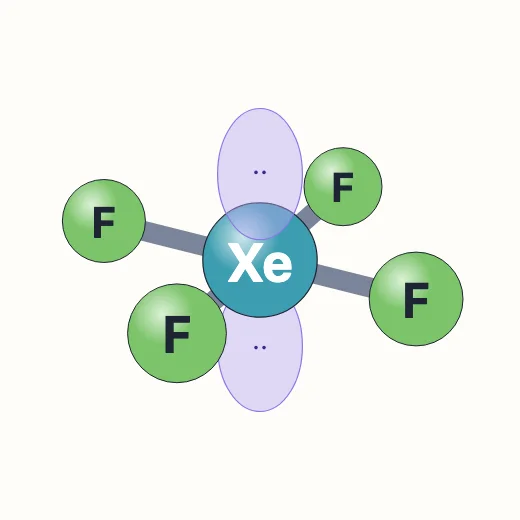
Xenon tetrafluoride was one of the first noble-gas compounds ever made, in 1962, by heating xenon with fluorine. It proved that a noble gas can form bonds, and its structure shows how two lone pairs can still leave a perfectly flat, symmetric molecule.
XeF4 Lewis structure, step by step
- Count valence electrons: Xe (8) + 4 × F (7) = 36 electrons.
- Central atom: Xe. Xenon is the least electronegative atom other than hydrogen (2.6), so it goes in the middle.
- Bond each outer atom to Xe (4 bonds = 8 electrons), then complete the outer atoms (4 × 6 electrons as lone pairs). That uses 32 electrons.
- 36 − 32 = 4 electrons left for Xe: 2 lone pairs.
- Electron domains on Xe: 4 bonded + 2 lone = 6 (steric number). A double or triple bond still counts as one domain.
- AX4E2: octahedral electron geometry, square planar molecular geometry, sp3d2 hybridization.
Shape, bond angle and hybridization
| Property | XeF4 |
|---|---|
| Valence electrons | 36 |
| Central atom | Xe |
| AXE | AX4E2 |
| Electron geometry | octahedral |
| Molecular geometry | square planar |
| Bond angle | 90° |
| Hybridization | sp3d2 |
| Polarity | Nonpolar |
Lone pairs on opposite sides
Xenon has six electron domains arranged octahedrally. If the two lone pairs sat next to each other at 90°, they would repel strongly; placing them on opposite sides, 180° apart, keeps them as far from each other as possible. The four fluorines are left in a square around xenon.
A noble gas with bonds
Xenon starts with a full set of 8 valence electrons, yet here it shares 4 of them with fluorine and keeps the other 4 as two lone pairs, for 12 electrons around Xe. Only very electronegative partners such as fluorine and oxygen can draw xenon's loosely held outer electrons into bonds.
Two lone pairs, still nonpolar
Lone pairs usually make a molecule polar, but here one points straight up and the other straight down, so their effects cancel. The four Xe–F dipoles (ΔEN 1.38) also cancel in opposite pairs, which leaves XeF4 with no net dipole.
Electron geometry vs shape
The electron geometry is octahedral because there are six domains; the molecular shape is square planar because you only name where the atoms are. The angle between neighbouring fluorines stays 90°, since the opposing lone pairs push equally from above and below.
Common mistakes
Watch out
- Putting the two lone pairs at 90° to each other and calling the shape seesaw or distorted; in an octahedron the second lone pair goes directly opposite the first.
- Giving xenon no lone pairs because it already has four bonds; 36 − 32 leaves 4 electrons, which are two lone pairs on Xe.
Practice questions
Try each one before opening the answer.
What is the steric number of Xe in XeF4?
6: four bonding domains plus two lone pairs. That matches an octahedral electron geometry and sp3d2 hybridization.
Why is XeF4 square planar rather than tetrahedral like CCl4?
CCl4 has 4 domains, but Xe has 6 once its two lone pairs are counted. Six domains form an octahedron, and with the lone pairs on opposite corners the four F atoms lie flat.
How many lone pairs appear in the complete XeF4 Lewis structure?
14: three on each of the four F atoms (12) plus two on Xe.
XeF4 compared with similar molecules
| Molecule | Valence e⁻ | AXE | Shape | Bond angle | Polarity |
|---|---|---|---|---|---|
| XeF4 | 36 e⁻ | AX4E2 | square planar | 90° | nonpolar |
| XeF2 | 22 e⁻ | AX2E3 | linear | 180° | nonpolar |
| SF6 | 48 e⁻ | AX6 | octahedral | 90° | nonpolar |
| BrF5 | 42 e⁻ | AX5E | square pyramidal | <90° | polar |
Where you meet it
XeF4 appears in inorganic chemistry courses and research labs as the headline example of noble-gas chemistry; it is a strong fluorinating agent that reacts with water.
Structure data: OpenStax Chemistry 2e, §7.6 Molecular Structure and Polarity. Shape rules: OpenStax Chemistry 2e §7.6.