Ammonia is a sharp-smelling gas and one of the most heavily produced chemicals in the world. The single lone pair on nitrogen sets its shape and is also what makes it a base.
NH3 Lewis structure, step by step
- Count valence electrons: N (5) + 3 × H (1) = 8 electrons.
- Central atom: N. Nitrogen is the least electronegative atom other than hydrogen (3.04), so it goes in the middle.
- Bond each outer atom to N (3 bonds = 6 electrons), then complete the outer atoms (hydrogen needs no lone pairs). That uses 6 electrons.
- 8 − 6 = 2 electrons left for N: 1 lone pair.
- Electron domains on N: 3 bonded + 1 lone = 4 (steric number). A double or triple bond still counts as one domain.
- AX3E: tetrahedral electron geometry, trigonal pyramidal molecular geometry, sp3 hybridization.
Shape, bond angle and hybridization
| Property | NH3 |
|---|---|
| Valence electrons | 8 |
| Central atom | N |
| AXE | AX3E |
| Electron geometry | tetrahedral |
| Molecular geometry | trigonal pyramidal |
| Bond angle | <109.5° ideal; 106.7° measured |
| Hybridization | sp3 |
| Polarity | Polar |
One lone pair on top
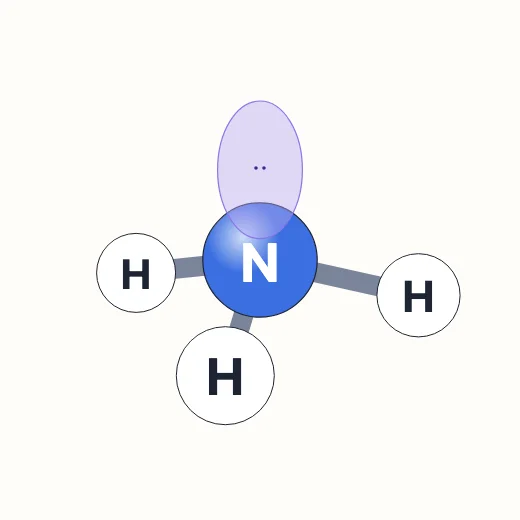
Nitrogen has five valence electrons; three go into bonds with hydrogen and two stay as a lone pair. The four domains point to the corners of a tetrahedron, and because the lone pair takes one corner, the atoms form a low pyramid with nitrogen at the peak.
Pyramid, not flat triangle
Students often mix up NH3 and BF3 because both have three outer atoms. Boron has no lone pair, so BF3 lies flat at 120°, while nitrogen's lone pair pushes the hydrogens down into a pyramid.
Between methane and water
Methane (no lone pairs) has 109.5°, ammonia (one lone pair) has 106.7° and water (two lone pairs) has 104.5°. Each extra lone pair squeezes the bonds a bit more, which makes this trio the standard demonstration of lone-pair repulsion.
The lone pair makes it a base
Nitrogen's lone pair can accept a proton (H+) to form the ammonium ion, NH4+. Once that pair becomes a fourth N–H bond, all four domains are alike and the ion is a perfect tetrahedron at 109.5°.
Common mistakes
Watch out
- Calling the shape tetrahedral: the electron geometry is tetrahedral, but with one corner taken by a lone pair the molecular shape is trigonal pyramidal.
- Forgetting the lone pair and drawing ammonia flat like BF3: place the leftover 2 electrons on nitrogen before you choose a shape.
Practice questions
Try each one before opening the answer.
How many electron domains surround nitrogen in NH3?
Four: three N–H bonding pairs and one lone pair, so the steric number is 4.
What happens to the shape when NH3 accepts H+ to become NH4+?
The lone pair turns into a fourth bond, so the ion becomes AX4: tetrahedral, with 109.5° angles.
Explain why ammonia is polar.
The three N–H bonds (ΔEN 0.84) all slope down from nitrogen with the lone pair above. Their dipoles add up to a net dipole instead of cancelling.
NH3 compared with similar molecules
| Molecule | Valence e⁻ | AXE | Shape | Bond angle | Polarity |
|---|---|---|---|---|---|
| NH3 | 8 e⁻ | AX3E | trigonal pyramidal | 106.7° | polar |
| PH3 | 8 e⁻ | AX3E | trigonal pyramidal | 93.5° | polar |
| NF3 | 26 e⁻ | AX3E | trigonal pyramidal | 102.5° | polar |
| BF3 | 24 e⁻ | AX3 | trigonal planar | 120° | nonpolar |
Where you meet it
Ammonia is made by the Haber process for fertilizers, is found in household glass cleaners, and is a common weak base in titration labs.
Shape rules: OpenStax Chemistry 2e §7.6.