Two kinds of position
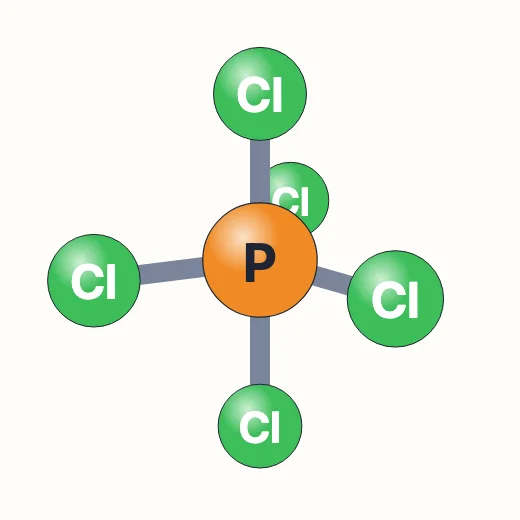
Unlike the tetrahedron and octahedron, the five corners of a trigonal bipyramid are not all equal:
- Equatorial (3 positions): in a triangle around the middle, 120° from each other and 90° from the two axial atoms.
- Axial (2 positions): straight up and down, 180° from each other and 90° from all three equatorial atoms.
An axial atom has three neighbours at 90°; an equatorial atom has only two. Crowding at 90° is what costs energy, so axial bonds end up slightly longer. In PCl5 the axial P–Cl bonds are measurably longer than the equatorial ones.
The family it starts
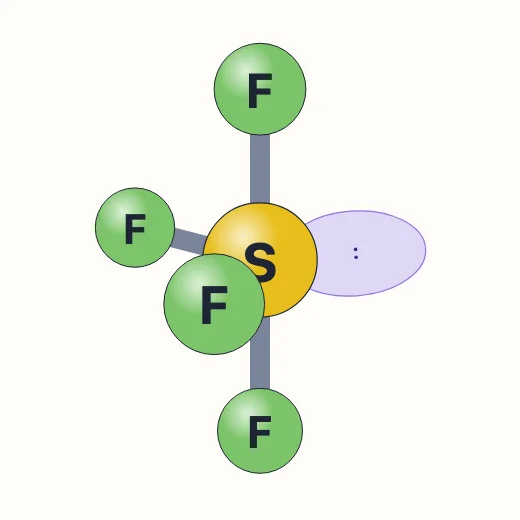
Five electron domains always give this electron geometry. Lone pairs go to equatorial positions first, where they have fewer 90° neighbours:
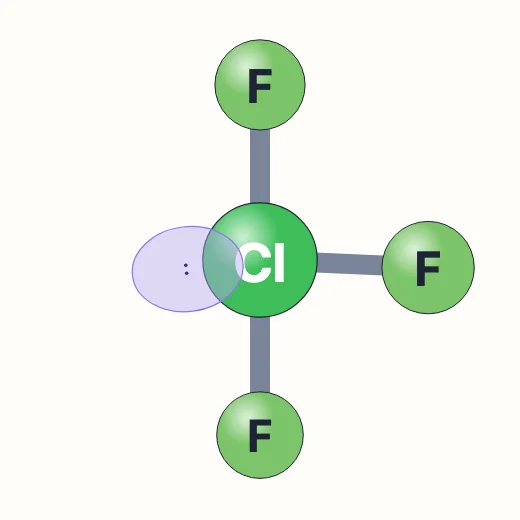
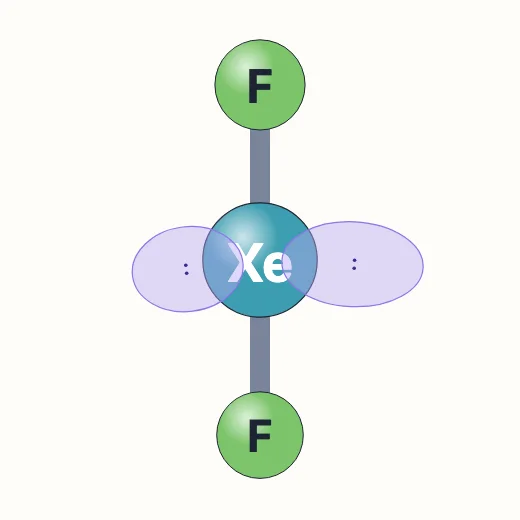
Expanded octets
Phosphorus in PCl5 has ten electrons around it in the usual Lewis drawing. Second-row atoms (C, N, O) never do this, and that is why NCl5 does not exist. Textbooks describe the centre as sp3d. Modern bonding models explain it without real d-orbital use, but the shape prediction is the same either way.
Polarity
With five identical outer atoms the dipoles cancel, so PCl5 and PF5 are nonpolar.
Every trigonal bipyramidal molecule on this site
| Molecule | Name | AXE | Central atom | Measured angle | Polarity |
|---|---|---|---|---|---|
| PCl5 | phosphorus pentachloride | AX5 | P | predicted 90°, 120° | nonpolar |
| PF5 | phosphorus pentafluoride | AX5 | P | predicted 90°, 120° | nonpolar |
| AsF5 | arsenic pentafluoride | AX5 | As | predicted 90°, 120° | nonpolar |
Tap any formula in the tool above, or open a linked molecule page for its Lewis structure and exam questions.
Exam traps
- Listing only 90° and 120°. Axial–axial is 180°, so a complete answer has three angles.
- Putting a lone pair in an axial spot when drawing SF4 or ClF3.