Sulfur tetrafluoride is a colorless, toxic gas that organic chemists use to swap oxygen atoms for fluorine. Its structure is the classic test of where a lone pair goes in a trigonal bipyramid: put it in the wrong spot and you end up with the wrong shape.
SF4 Lewis structure, step by step
- Count valence electrons: S (6) + 4 × F (7) = 34 electrons.
- Central atom: S. Sulfur is the least electronegative atom other than hydrogen (2.58), so it goes in the middle.
- Bond each outer atom to S (4 bonds = 8 electrons), then complete the outer atoms (4 × 6 electrons as lone pairs). That uses 32 electrons.
- 34 − 32 = 2 electrons left for S: 1 lone pair.
- Electron domains on S: 4 bonded + 1 lone = 5 (steric number). A double or triple bond still counts as one domain.
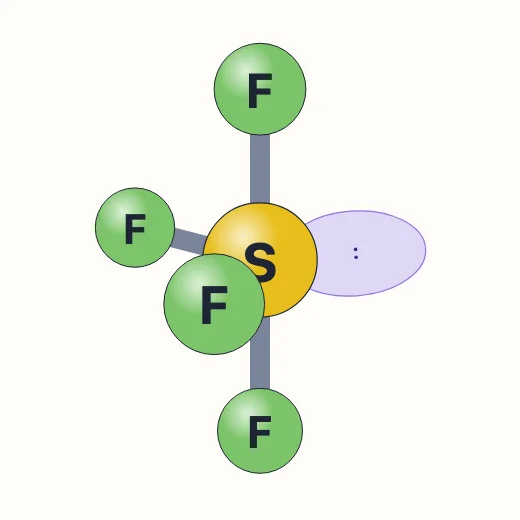
- AX4E: trigonal bipyramidal electron geometry, seesaw molecular geometry, sp3d hybridization.
Shape, bond angle and hybridization
| Property | SF4 |
|---|---|
| Valence electrons | 34 |
| Central atom | S |
| AXE | AX4E |
| Electron geometry | trigonal bipyramidal |
| Molecular geometry | seesaw |
| Bond angle | <90°, <120° ideal; F(ax)–S–F(ax) 173.1°, F(eq)–S–F(eq) 101.6° measured |
| Hybridization | sp3d |
| Polarity | Polar |
The lone pair takes an equatorial seat
Sulfur has five electron domains, so they spread into a trigonal bipyramid. An equatorial position has only two neighbours at 90°, while an axial one has three, so the lone pair goes equatorial where it is least crowded. Leave that corner out of the drawing and you see the seesaw: two axial F atoms and two equatorial F atoms.
Reading the measured angles
The two axial fluorines are 173.1° apart instead of a straight 180°, because the lone pair pushes them back toward the far side. The two equatorial fluorines sit at 101.6°, far below the ideal 120°, for the same reason. Both numbers bend away from the lone pair.
Ten electrons around sulfur
Four bonds and one lone pair put 10 electrons around S, so SF4 is drawn as an expanded octet. Sulfur is in period 3, which is why textbooks allow it; fluorine, in period 2, never goes past 8. A more modern view, the 3-centre-4-electron bond, explains the nearly straight axial F–S–F unit without needing extra orbitals on sulfur.
Why it is polar while SF6 is not
In SF6 six identical bonds point to the corners of an octahedron and cancel. In SF4 one corner of the bipyramid holds a lone pair instead of a bond, so the S–F dipoles (ΔEN 1.40) add up to a net dipole along the seesaw's axis of symmetry.
Common mistakes
Watch out
- Placing the lone pair in an axial position, which gives a trigonal pyramid instead of a seesaw; in a five-domain molecule, lone pairs always fill equatorial positions first.
- Stopping at 32 electrons and forgetting the last pair; 34 − 32 leaves 2 electrons that must go on sulfur as a lone pair.
Practice questions
Try each one before opening the answer.
How many lone pairs are in the whole SF4 Lewis structure, counting the fluorines?
Each F carries 3 lone pairs (12 in total) and S carries 1, giving 13 lone pairs. Check: 13 × 2 + 4 bonds × 2 = 34 electrons.
What is the hybridization of sulfur in SF4, and how do you get it?
sp3d. Sulfur has 4 bonding domains plus 1 lone pair, a steric number of 5, which needs five hybrid orbitals.
Predict whether the equatorial F–S–F angle is larger or smaller than 120°, and explain.
Smaller: it is measured at 101.6°. The equatorial lone pair repels more strongly than a bonding pair and squeezes the two equatorial bonds together.
SF4 compared with similar molecules
| Molecule | Valence e⁻ | AXE | Shape | Bond angle | Polarity |
|---|---|---|---|---|---|
| SF4 | 34 e⁻ | AX4E | seesaw | F(ax)–S–F(ax) 173.1°, F(eq)–S–F(eq) 101.6° | polar |
| SF6 | 48 e⁻ | AX6 | octahedral | 90° | nonpolar |
| ClF3 | 28 e⁻ | AX3E2 | T-shaped | 87.5° | polar |
| PCl5 | 40 e⁻ | AX5 | trigonal bipyramidal | 90°, 120° | nonpolar |
Where you meet it
SF4 turns up in organic synthesis labs as a reagent that converts C=O groups into CF2 groups and alcohols into fluorides.
Shape rules: OpenStax Chemistry 2e §7.6.