Phosphine is the phosphorus cousin of ammonia: three hydrogens on a central P that still keeps one lone pair. On paper it looks just like NH3, yet its bond angle shrinks to 93.5°, almost a right angle, and that gap is why teachers love to ask about it.
PH3 Lewis structure, step by step
- Count valence electrons: P (5) + 3 × H (1) = 8 electrons.
- Central atom: P. Phosphorus is the least electronegative atom other than hydrogen (2.19), so it goes in the middle.
- Bond each outer atom to P (3 bonds = 6 electrons), then complete the outer atoms (hydrogen needs no lone pairs). That uses 6 electrons.
- 8 − 6 = 2 electrons left for P: 1 lone pair.
- Electron domains on P: 3 bonded + 1 lone = 4 (steric number). A double or triple bond still counts as one domain.
- AX3E: tetrahedral electron geometry, trigonal pyramidal molecular geometry, sp3 hybridization.
Shape, bond angle and hybridization
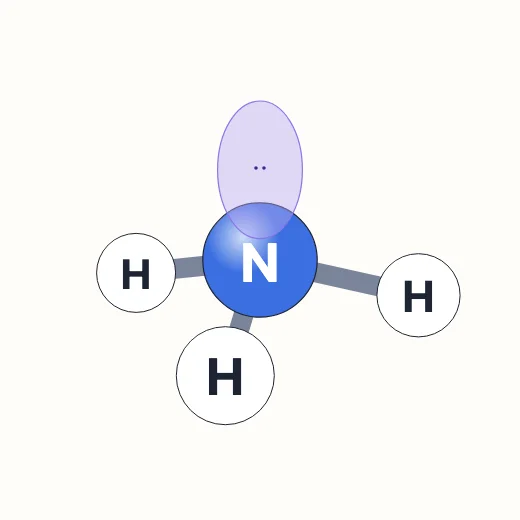
| Property | PH3 |
|---|---|
| Valence electrons | 8 |
| Central atom | P |
| AXE | AX3E |
| Electron geometry | tetrahedral |
| Molecular geometry | trigonal pyramidal |
| Bond angle | <109.5° ideal; 93.5° measured |
| Hybridization | sp3 |
| Polarity | Polar |
Why the angle is so much smaller than in NH3
VSEPR only promises a little under 109.5° for an AX3E molecule, and NH3 lands near 107°. Phosphorus is a bigger atom, so its bonding pairs sit farther from the nucleus and from each other and repel less, letting the lone pair squeeze them together. An angle of 93.5° hints that P bonds mostly through its p orbitals, even though the domain-count label is still sp3.
Bonds that are almost nonpolar
Phosphorus (2.19) and hydrogen (2.20) have nearly identical electronegativities, a gap of just 0.01. So the polarity of PH3 comes almost entirely from the lone pair and the pyramid, not from the bonds. That is why its dipole moment (about 0.58 D) is far smaller than ammonia's (about 1.47 D).
No hydrogen bonding
P is not N, O or F, and the P–H bond is barely polar, so phosphine molecules cannot hydrogen-bond to one another. NH3 boils at about −33 °C while PH3 boils near −88 °C, a classic pair of numbers for showing how much hydrogen bonding matters.
Common mistakes
Watch out
- Calling PH3 trigonal planar because three atoms surround P; the lone pair still takes up a domain, so the shape is trigonal pyramidal.
- Writing 107° for the angle by copying ammonia; for PH3 the measured value is 93.5°, well below the 109.5° guide.
Practice questions
Try each one before opening the answer.
How many lone pairs sit on the central atom of PH3, and how do you know?
One. P brings 5 and the three H atoms bring 3, giving 8 valence electrons; three P–H bonds use 6, so the last 2 form a single lone pair on P.
Predict the electron geometry and the molecular geometry of PH3.
Four domains (3 bonds + 1 lone pair) give a tetrahedral electron geometry. Looking only at the atoms, P and the three H form a trigonal pyramid.
Which has the larger bond angle, NH3 or PH3? Explain.
NH3 (about 107°) beats PH3 (93.5°). On the small N atom the bonding pairs crowd close to the center and push each other apart strongly; on the larger P they sit farther out and the lone pair compresses them.
PH3 compared with similar molecules
| Molecule | Valence e⁻ | AXE | Shape | Bond angle | Polarity |
|---|---|---|---|---|---|
| PH3 | 8 e⁻ | AX3E | trigonal pyramidal | 93.5° | polar |
| NH3 | 8 e⁻ | AX3E | trigonal pyramidal | 106.7° | polar |
| PCl3 | 26 e⁻ | AX3E | trigonal pyramidal | 100.3° | polar |
| H2S | 8 e⁻ | AX2E2 | bent | 92.1° | polar |
Where you meet it
Phosphine shows up as the toxic fumigant gas released from metal phosphide pellets in grain stores, and as a dopant source in semiconductor manufacturing.
Shape rules: OpenStax Chemistry 2e §7.6.