Hydrogen cyanide is a small, highly toxic molecule made of three different atoms in a row. It proves that a linear molecule can still be polar when its two ends are not the same.
HCN Lewis structure, step by step
- Count valence electrons: H (1) + C (4) + N (5) = 10 electrons.
- Central atom: C. Carbon is the least electronegative atom other than hydrogen (2.55), so it goes in the middle.
- Bond each outer atom to C (2 bonds = 4 electrons), then complete the outer atoms (1 × 6 electrons as lone pairs; hydrogen needs no lone pairs). That uses 10 electrons.
- 10 − 10 = 0 electrons left for C, so it has no lone pairs.
- That leaves C with only 4 electrons, short of an octet. Move two lone pairs from the outer atom into the bond: one C≡N triple bond. Now C has 8.
- Electron domains on C: 2 bonded + 0 lone = 2 (steric number). A double or triple bond still counts as one domain.
- AX2: linear electron geometry, linear molecular geometry, sp hybridization.
Shape, bond angle and hybridization
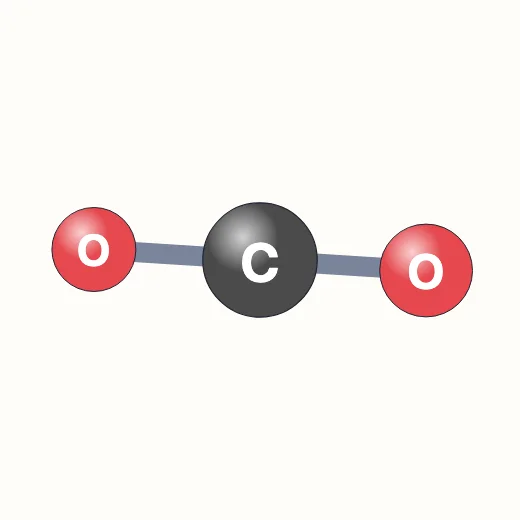
| Property | HCN |
|---|---|
| Valence electrons | 10 |
| Central atom | C |
| AXE | AX2 |
| Electron geometry | linear |
| Molecular geometry | linear |
| Bond angle | 180° |
| Hybridization | sp |
| Polarity | Polar |
Why carbon is in the middle
Hydrogen can only form one bond, so it can never be a central atom. Between carbon and nitrogen, carbon is less electronegative and wants four bonds, so the skeleton is H–C–N.
Filling the octets with a triple bond
With single bonds only, nitrogen gets its octet but carbon has just four electrons. Shifting two of nitrogen's lone pairs into the C–N bond builds a triple bond, giving carbon four bonds, nitrogen one lone pair, and every formal charge zero.
Linear but polar
Carbon's two domains, the H–C bond and the C≡N triple bond, sit at 180°. Unlike CO2, the two ends differ: nitrogen pulls electron density toward itself and the nearly nonpolar C–H bond cannot balance it, so the net dipole points toward N.
Counting sigma and pi bonds
HCN has 2 sigma bonds (H–C and one inside C≡N) and 2 pi bonds, both in the triple bond. Those pi bonds use carbon's two leftover unhybridized p orbitals, which is why carbon is sp.
Common mistakes
Watch out
- Putting nitrogen in the middle (H–N–C): carbon is central because it is less electronegative and forms four bonds.
- Assuming every linear molecule is nonpolar: dipoles only cancel when both ends are identical, as in CO2.
Practice questions
Try each one before opening the answer.
How many lone pairs are in HCN, and on which atom?
One, on nitrogen. The H–C bond and the C≡N triple bond use 8 of the 10 valence electrons, and the last 2 form a lone pair on N.
What is the H–C–N bond angle?
180°. Carbon has two electron domains and no lone pairs, so the molecule is linear.
Which is polar, HCN or CO2? Why?
HCN. Both are linear, but CO2 has identical ends whose dipoles cancel, while HCN has hydrogen at one end and nitrogen at the other, so its dipole survives.
HCN compared with similar molecules
| Molecule | Valence e⁻ | AXE | Shape | Bond angle | Polarity |
|---|---|---|---|---|---|
| HCN | 10 e⁻ | AX2 | linear | 180° | polar |
| CO2 | 16 e⁻ | AX2 | linear | 180° | nonpolar |
| N2 | 10 e⁻ | diatomic | linear | 180° | nonpolar |
| CO | 10 e⁻ | diatomic | linear | 180° | polar |
Where you meet it
Students meet HCN in organic chemistry, where the cyanide (C≡N) group is used to add a carbon atom to a molecule, and in industry it is a starting material for acrylic plastics.
Structure data: OpenStax Chemistry 2e, §7.6 Molecular Structure and Polarity. Shape rules: OpenStax Chemistry 2e §7.6.