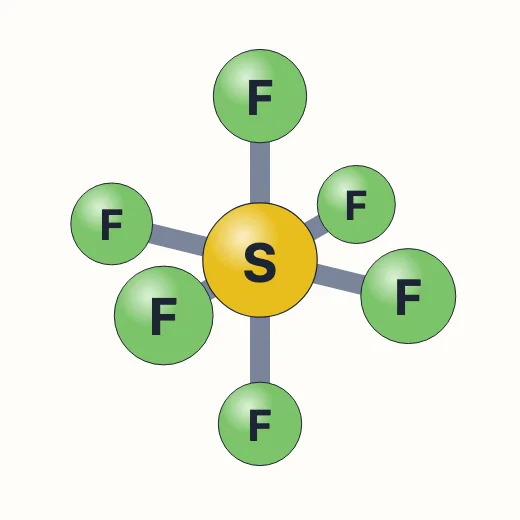
Sulfur hexafluoride is a heavy, unreactive gas packed into high-voltage electrical equipment. Its Lewis structure is about as tidy as it gets: every valence electron of sulfur is used in bonding, and the six fluorines sit at the corners of a perfect octahedron.
SF6 Lewis structure, step by step
- Count valence electrons: S (6) + 6 × F (7) = 48 electrons.
- Central atom: S. Sulfur is the least electronegative atom other than hydrogen (2.58), so it goes in the middle.
- Bond each outer atom to S (6 bonds = 12 electrons), then complete the outer atoms (6 × 6 electrons as lone pairs). That uses 48 electrons.
- 48 − 48 = 0 electrons left for S, so it has no lone pairs.
- Electron domains on S: 6 bonded + 0 lone = 6 (steric number). A double or triple bond still counts as one domain.
- AX6: octahedral electron geometry, octahedral molecular geometry, sp3d2 hybridization.
Shape, bond angle and hybridization
| Property | SF6 |
|---|---|
| Valence electrons | 48 |
| Central atom | S |
| AXE | AX6 |
| Electron geometry | octahedral |
| Molecular geometry | octahedral |
| Bond angle | 90° |
| Hybridization | sp3d2 |
| Polarity | Nonpolar |
Twelve electrons on one atom
Six bonds put 12 electrons around sulfur, the biggest expanded octet most students meet. The drawing needs no double bonds: with six S–F single bonds, every atom has a formal charge of zero.
Every neighbouring angle is 90°
With six identical domains and no lone pairs, nothing distorts the shape. Each F–S–F angle between neighbouring fluorines is exactly 90°, and the three pairs of opposite fluorines are 180° apart. Unlike a trigonal bipyramid, there are no axial or equatorial positions: all six corners are equivalent.
Polar bonds, nonpolar molecule
Fluorine pulls hard on sulfur's electrons (ΔEN 1.40), so each bond is strongly polar. But every bond has an identical partner pointing the opposite way, so the six dipoles cancel in pairs and the molecule has no net dipole.
Why it hardly reacts
Six fluorines crowd around a small sulfur atom and shield it from attack, which makes SF6 remarkably unreactive. That stability makes it a good electrical insulator, and also means it lingers for thousands of years in the atmosphere as a very powerful greenhouse gas.
Common mistakes
Watch out
- Assuming sulfur cannot hold more than 8 electrons and inventing a structure with fewer bonds; sulfur is in period 3, and the standard drawing shows six single bonds and 12 electrons on S.
- Writing the hybridization as sp3d; six domains need six hybrid orbitals, so it is sp3d2.
Practice questions
Try each one before opening the answer.
How many valence electrons does SF6 have, and where do they all go?
6 + 6 × 7 = 48. Twelve go into the six bonds, and the remaining 36 sit as three lone pairs on each fluorine, leaving none on sulfur.
If one fluorine in SF6 were replaced by chlorine (SF5Cl), would the molecule still be nonpolar?
No. The shape stays roughly octahedral, but the S–Cl bond dipole differs from the S–F dipole opposite it, so they no longer cancel and the molecule becomes polar.
What is the F–S–F angle between two fluorines on opposite corners?
180°. Opposite corners of an octahedron lie on a straight line through sulfur; only adjacent fluorines are 90° apart.
SF6 compared with similar molecules
| Molecule | Valence e⁻ | AXE | Shape | Bond angle | Polarity |
|---|---|---|---|---|---|
| SF6 | 48 e⁻ | AX6 | octahedral | 90° | nonpolar |
| XeF4 | 36 e⁻ | AX4E2 | square planar | 90° | nonpolar |
| SF4 | 34 e⁻ | AX4E | seesaw | F(ax)–S–F(ax) 173.1°, F(eq)–S–F(eq) 101.6° | polar |
| PCl5 | 40 e⁻ | AX5 | trigonal bipyramidal | 90°, 120° | nonpolar |
Where you meet it
SF6 is sealed inside high-voltage circuit breakers and switchgear, where it stops sparks from jumping between conductors.
Structure data: OpenStax Chemistry 2e, §7.6 Molecular Structure and Polarity. Shape rules: OpenStax Chemistry 2e §7.6.