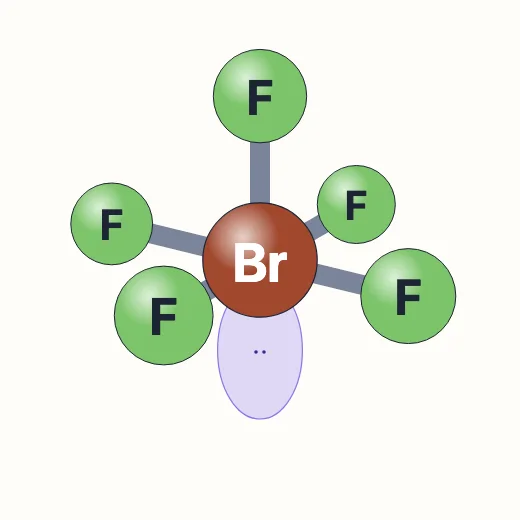
BrF5 packs five fluorines and one lone pair around a single bromine, twelve electrons in all. It is the standard example of a square pyramid: an octahedron with one corner taken by a lone pair.
BrF5 Lewis structure, step by step
- Count valence electrons: Br (7) + 5 × F (7) = 42 electrons.
- Central atom: Br. Bromine is the least electronegative atom other than hydrogen (2.96), so it goes in the middle.
- Bond each outer atom to Br (5 bonds = 10 electrons), then complete the outer atoms (5 × 6 electrons as lone pairs). That uses 40 electrons.
- 42 − 40 = 2 electrons left for Br: 1 lone pair.
- Electron domains on Br: 5 bonded + 1 lone = 6 (steric number). A double or triple bond still counts as one domain.
- AX5E: octahedral electron geometry, square pyramidal molecular geometry, sp3d2 hybridization.
Shape, bond angle and hybridization
| Property | BrF5 |
|---|---|
| Valence electrons | 42 |
| Central atom | Br |
| AXE | AX5E |
| Electron geometry | octahedral |
| Molecular geometry | square pyramidal |
| Bond angle | <90° |
| Hybridization | sp3d2 |
| Polarity | Polar |
Counting to 42
Bromine and each of the five fluorines bring 7 electrons, for 42. Five bonds plus three lone pairs on every F use 40, so the final 2 electrons sit on bromine as one lone pair.
Six domains, one you cannot see
Five bonds and one lone pair make six domains aimed at the corners of an octahedron. All six corners are equivalent, so it does not matter which one the lone pair takes; removing it leaves four F atoms in a square base and one on top.
The base tilts up
The lone pair sits beneath the square base and pushes the four basal fluorines slightly toward the apical one, so the apical-to-basal F–Br–F angle is a little under 90°. Bromine ends up just below the plane of the four basal fluorines.
Polar despite five identical bonds
Five identical Br–F bonds might seem to cancel, but the lone pair leaves one corner of the octahedron empty. The apical bond has no partner opposite it, so the molecule carries a net dipole along that axis.
Common mistakes
Watch out
- Calling BrF5 trigonal bipyramidal like PCl5; the extra lone pair makes six domains, so the parent geometry is octahedral.
- Missing the lone pair because the fluorine lone pairs already crowd the page; subtract 42 − 40 = 2 to find it.
Practice questions
Try each one before opening the answer.
Compare the electron geometry and the molecular geometry of BrF5.
Six domains give an octahedral electron geometry. Ignoring the lone pair, the five F atoms form a square pyramid.
What is the hybridization of Br in BrF5?
sp3d2, matching six electron domains (five bonds and one lone pair).
Why is BrF5 polar while SF6 is not?
SF6 has a bond at every corner of the octahedron, so the dipoles cancel in pairs. In BrF5 one corner is a lone pair, leaving the apical Br–F bond unbalanced.
BrF5 compared with similar molecules
| Molecule | Valence e⁻ | AXE | Shape | Bond angle | Polarity |
|---|---|---|---|---|---|
| BrF5 | 42 e⁻ | AX5E | square pyramidal | <90° | polar |
| XeF4 | 36 e⁻ | AX4E2 | square planar | 90° | nonpolar |
| SF6 | 48 e⁻ | AX6 | octahedral | 90° | nonpolar |
| PCl5 | 40 e⁻ | AX5 | trigonal bipyramidal | 90°, 120° | nonpolar |
Where you meet it
Bromine pentafluoride is a very reactive fluorinating agent, met mostly in inorganic chemistry alongside other interhalogens such as ClF3.
Structure data: OpenStax Chemistry 2e, §7.6 Molecular Structure and Polarity. Shape rules: OpenStax Chemistry 2e §7.6.