Phosphorus pentachloride is a pale yellow-white solid that fumes in moist air. It is the textbook trigonal bipyramid, the one common shape where not every outer position is the same.
PCl5 Lewis structure, step by step
- Count valence electrons: P (5) + 5 × Cl (7) = 40 electrons.
- Central atom: P. Phosphorus is the least electronegative atom other than hydrogen (2.19), so it goes in the middle.
- Bond each outer atom to P (5 bonds = 10 electrons), then complete the outer atoms (5 × 6 electrons as lone pairs). That uses 40 electrons.
- 40 − 40 = 0 electrons left for P, so it has no lone pairs.
- Electron domains on P: 5 bonded + 0 lone = 5 (steric number). A double or triple bond still counts as one domain.
- AX5: trigonal bipyramidal electron geometry, trigonal bipyramidal molecular geometry, sp3d hybridization.
Shape, bond angle and hybridization
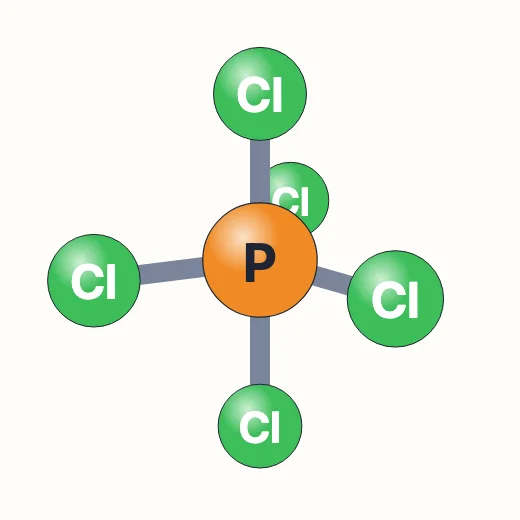
| Property | PCl5 |
|---|---|
| Valence electrons | 40 |
| Central atom | P |
| AXE | AX5 |
| Electron geometry | trigonal bipyramidal |
| Molecular geometry | trigonal bipyramidal |
| Bond angle | 90°, 120° |
| Hybridization | sp3d |
| Polarity | Nonpolar |
Two kinds of chlorine
Three chlorines lie in a flat triangle around P, 120° apart (equatorial), and two sit above and below at 90° to that plane (axial). Axial chlorines have three neighbours at 90° while equatorial ones have only two, so the axial P–Cl bonds are slightly longer.
Five bonds, ten electrons
Phosphorus uses all five of its valence electrons in bonds, which gives it 10 electrons and no lone pair. That expanded octet is allowed for a period 3 atom; nitrogen, directly above phosphorus, cannot form NCl5.
Nonpolar thanks to balanced geometry
Each P–Cl bond is polar (ΔEN 0.97). The two axial dipoles cancel each other along the vertical axis, and the three equatorial dipoles, 120° apart, cancel within the plane, so the molecule has no net dipole.
Solid PCl5 is ionic
The trigonal bipyramid describes PCl5 as a gas or dissolved in nonpolar solvents. In the solid it rearranges into tetrahedral [PCl4]+ and octahedral [PCl6]− ions, so one formula gives three different VSEPR shapes.
Common mistakes
Watch out
- Saying all bond angles in PCl5 are 90° or all are 120°; it has both, 120° within the equator and 90° between axial and equatorial bonds, plus 180° between the two axial bonds.
- Giving phosphorus a lone pair out of habit from PCl3; in PCl5, 40 − 40 leaves nothing for P.
Practice questions
Try each one before opening the answer.
How many lone pairs are in the PCl5 Lewis structure?
15, three on each chlorine; phosphorus has none. Check: 15 × 2 + 5 × 2 = 40 electrons.
How many 90° Cl–P–Cl angles does PCl5 have?
Six. Each of the two axial chlorines makes a 90° angle with each of the three equatorial chlorines (2 × 3 = 6).
What hybridization does P use in PCl5?
sp3d: five bonding domains need five hybrid orbitals, aimed at the corners of a trigonal bipyramid.
PCl5 compared with similar molecules
| Molecule | Valence e⁻ | AXE | Shape | Bond angle | Polarity |
|---|---|---|---|---|---|
| PCl5 | 40 e⁻ | AX5 | trigonal bipyramidal | 90°, 120° | nonpolar |
| PCl3 | 26 e⁻ | AX3E | trigonal pyramidal | 100.3° | polar |
| SF4 | 34 e⁻ | AX4E | seesaw | F(ax)–S–F(ax) 173.1°, F(eq)–S–F(eq) 101.6° | polar |
| SF6 | 48 e⁻ | AX6 | octahedral | 90° | nonpolar |
Where you meet it
In organic labs PCl5 is a chlorinating reagent that turns alcohols into alkyl chlorides and carboxylic acids into acid chlorides.
Structure data: OpenStax Chemistry 2e, §7.6 Molecular Structure and Polarity. Shape rules: OpenStax Chemistry 2e §7.6.