Carbon tetrafluoride is a small, perfectly symmetric molecule built from some of the most polar single bonds in chemistry. It is a favorite exam case for showing that polar bonds do not automatically make a polar molecule.
CF4 Lewis structure, step by step
- Count valence electrons: C (4) + 4 × F (7) = 32 electrons.
- Central atom: C. Carbon is the least electronegative atom other than hydrogen (2.55), so it goes in the middle.
- Bond each outer atom to C (4 bonds = 8 electrons), then complete the outer atoms (4 × 6 electrons as lone pairs). That uses 32 electrons.
- 32 − 32 = 0 electrons left for C, so it has no lone pairs.
- Electron domains on C: 4 bonded + 0 lone = 4 (steric number). A double or triple bond still counts as one domain.
- AX4: tetrahedral electron geometry, tetrahedral molecular geometry, sp3 hybridization.
Shape, bond angle and hybridization
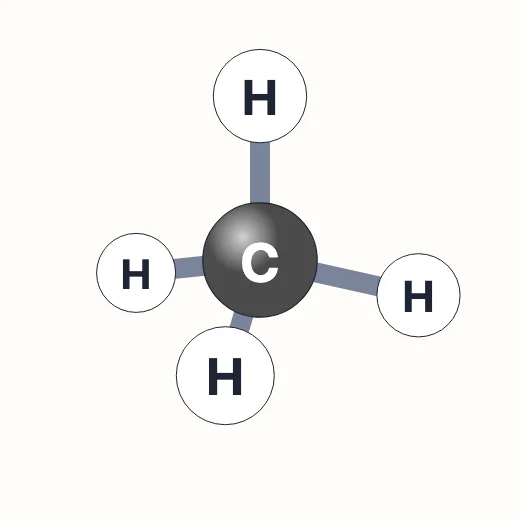
| Property | CF4 |
|---|---|
| Valence electrons | 32 |
| Central atom | C |
| AXE | AX4 |
| Electron geometry | tetrahedral |
| Molecular geometry | tetrahedral |
| Bond angle | 109.5° |
| Hybridization | sp3 |
| Polarity | Nonpolar |
Very polar bonds, zero dipole
Fluorine (3.98) and carbon (2.55) differ by 1.43 in electronegativity, so each C–F bond has a large dipole pointing toward F. Four identical dipoles aimed at the corners of a tetrahedron still add up to exactly zero.
Mostly lone pairs
Only 8 of the 32 valence electrons are in bonds; the other 24 sit as three lone pairs on each fluorine. A complete drawing shows all 12 lone pairs, and leaving them out is where many students lose marks.
Gas, while CCl4 is a liquid
CF4 and CCl4 have the same tetrahedral, nonpolar structure, so only London forces hold their molecules together. Chlorine's larger, more polarizable electron cloud makes those forces much stronger, which is why CCl4 is a liquid at room temperature and CF4 is a gas.
Stable to a fault
The C–F bond is one of the strongest single bonds carbon forms, so CF4 barely reacts. That stability means it lingers in the atmosphere for tens of thousands of years as a potent greenhouse gas.
Common mistakes
Watch out
- Calling CF4 polar because the C–F bond is polar; the symmetric tetrahedron cancels all four bond dipoles.
- Drawing CF4 as a flat square with 90° angles; four domains around carbon spread out to 109.5° in three dimensions.
Practice questions
Try each one before opening the answer.
How many lone pairs are in the Lewis structure of CF4?
Twelve, three on each F and none on C: (32 − 8) ÷ 2 = 12.
State the bond angle and hybridization in CF4.
109.5° and sp3, since carbon has four bonding domains and no lone pair.
Explain why CF4 has a lower boiling point than CCl4.
Both are nonpolar, so only London forces act. Chlorine atoms are bigger and more polarizable than fluorine atoms, so CCl4 has stronger London forces and boils higher.
CF4 compared with similar molecules
| Molecule | Valence e⁻ | AXE | Shape | Bond angle | Polarity |
|---|---|---|---|---|---|
| CF4 | 32 e⁻ | AX4 | tetrahedral | 109.5° | nonpolar |
| CCl4 | 32 e⁻ | AX4 | tetrahedral | 109.5° | nonpolar |
| CH4 | 8 e⁻ | AX4 | tetrahedral | 109.5° | nonpolar |
| SF4 | 34 e⁻ | AX4E | seesaw | F(ax)–S–F(ax) 173.1°, F(eq)–S–F(eq) 101.6° | polar |
Where you meet it
CF4 is used in plasma etching of silicon chips and is released as a by-product of aluminium smelting.
Structure data: OpenStax Chemistry 2e, §7.6 Molecular Structure and Polarity. Shape rules: OpenStax Chemistry 2e §7.6.