Carbon tetrachloride is a dense, colorless liquid that was once a common cleaning solvent and fire-extinguisher filling. It is the standard example of a molecule whose bonds are polar but which is nonpolar overall.
CCl4 Lewis structure, step by step
- Count valence electrons: C (4) + 4 × Cl (7) = 32 electrons.
- Central atom: C. Carbon is the least electronegative atom other than hydrogen (2.55), so it goes in the middle.
- Bond each outer atom to C (4 bonds = 8 electrons), then complete the outer atoms (4 × 6 electrons as lone pairs). That uses 32 electrons.
- 32 − 32 = 0 electrons left for C, so it has no lone pairs.
- Electron domains on C: 4 bonded + 0 lone = 4 (steric number). A double or triple bond still counts as one domain.
- AX4: tetrahedral electron geometry, tetrahedral molecular geometry, sp3 hybridization.
Shape, bond angle and hybridization
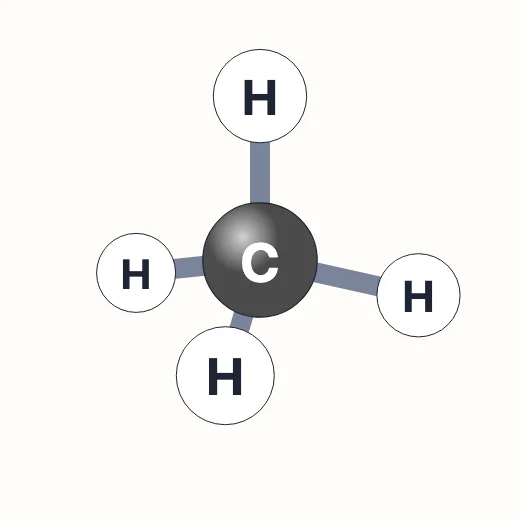
| Property | CCl4 |
|---|---|
| Valence electrons | 32 |
| Central atom | C |
| AXE | AX4 |
| Electron geometry | tetrahedral |
| Molecular geometry | tetrahedral |
| Bond angle | 109.5° |
| Hybridization | sp3 |
| Polarity | Nonpolar |
Lots of electrons, simple shape
Of the 32 valence electrons, only 8 are in bonds; the other 24 are lone pairs on the chlorines. Lone pairs on outer atoms do not change the shape. Carbon itself has four bonding domains and nothing else, which gives a perfect tetrahedron.
How the dipoles cancel
Each C–Cl bond is polar (ΔEN 0.61), with the chlorine end slightly negative. In a regular tetrahedron the four bond vectors add to zero: whichever direction you look along, the pulls balance. So the molecule has no net dipole.
Swap one Cl and polarity appears
Replace one chlorine with hydrogen and you get chloroform, CHCl3, which is polar. The shape is still roughly tetrahedral, but a C–H bond pulls much less than C–Cl, so the dipoles no longer balance. Symmetry of the outer atoms, not the shape name alone, decides polarity.
Why it dissolves grease, not salt
Being nonpolar, CCl4 mixes well with oils, fats and iodine but not with water. That like-dissolves-like behaviour made it a dry-cleaning solvent; it was phased out because it damages the liver and destroys stratospheric ozone.
Common mistakes
Watch out
- Calling CCl4 polar because the C–Cl bonds are polar; bond polarity and molecular polarity are different questions, and the symmetric tetrahedron cancels the bond dipoles.
- Drawing it flat like a plus sign with 90° angles; the four chlorines point to the corners of a tetrahedron, 109.5° apart.
Practice questions
Try each one before opening the answer.
How many lone pairs are on the central carbon in CCl4?
None. After four C–Cl bonds and three lone pairs on each Cl, 32 − 32 = 0 electrons are left for carbon.
Which has a dipole moment, CCl4 or CH2Cl2? Explain.
CH2Cl2. Both are tetrahedral around carbon, but its two C–Cl and two C–H bonds differ in polarity and do not cancel, while the four identical bonds of CCl4 do.
What orbitals does carbon use to bond in CCl4?
Four sp3 hybrid orbitals, one aimed at each chlorine, because carbon has a steric number of 4.
CCl4 compared with similar molecules
| Molecule | Valence e⁻ | AXE | Shape | Bond angle | Polarity |
|---|---|---|---|---|---|
| CCl4 | 32 e⁻ | AX4 | tetrahedral | 109.5° | nonpolar |
| CH4 | 8 e⁻ | AX4 | tetrahedral | 109.5° | nonpolar |
| CF4 | 32 e⁻ | AX4 | tetrahedral | 109.5° | nonpolar |
| CHCl3 | 26 e⁻ | AX4 | tetrahedral | 109.5° | polar |
Where you meet it
Students mostly meet CCl4 in textbooks and older lab manuals as a nonpolar solvent; its use is now restricted under the Montreal Protocol because it depletes the ozone layer.
Structure data: OpenStax Chemistry 2e, §7.6 Molecular Structure and Polarity. Shape rules: OpenStax Chemistry 2e §7.6.