Nitrous oxide, better known as laughing gas, has the same 16 valence electrons as CO2 and is also linear. The twist is the atom order: it is N–N–O, not N–O–N, and because the two ends differ, the molecule has a small dipole.
N2O Lewis structure, step by step
- Count valence electrons: 2 × N (5) + O (6) = 16 electrons.
- Central atom: N. Nitrogen is the least electronegative atom other than hydrogen (3.04), so it goes in the middle.
- Bond each outer atom to N (2 bonds = 4 electrons), then complete the outer atoms (2 × 6 electrons as lone pairs). That uses 16 electrons.
- 16 − 16 = 0 electrons left for N, so it has no lone pairs.
- That leaves N with only 4 electrons, short of an octet. Move two lone pairs from the outer atom into the bond: one N≡N triple bond. Now N has 8.
- Electron domains on N: 2 bonded + 0 lone = 2 (steric number). A double or triple bond still counts as one domain.
- AX2: linear electron geometry, linear molecular geometry, sp hybridization.
Shape, bond angle and hybridization
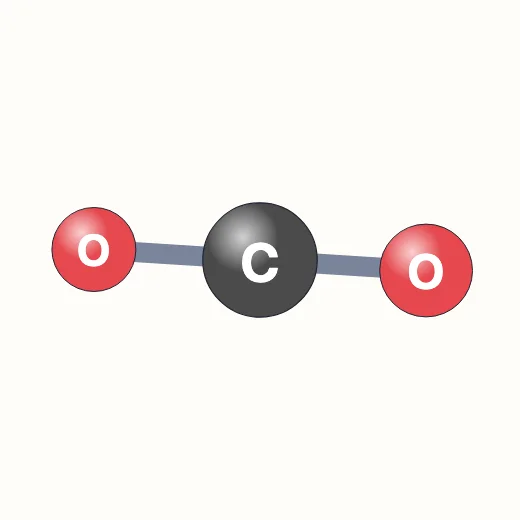
| Property | N2O |
|---|---|
| Valence electrons | 16 |
| Central atom | N |
| AXE | AX2 |
| Electron geometry | linear |
| Molecular geometry | linear |
| Bond angle | 180° |
| Hybridization | sp |
| Polarity | Polar |
Why a nitrogen is in the middle
Oxygen is the most electronegative atom here, so it goes on the outside, leaving one N in the center bonded to the other N and to O. Formal charges agree: an N–O–N arrangement would force +2 onto the central oxygen, while N–N–O keeps every charge at +1, 0 or −1.
Two main resonance forms
One form is N=N=O, with −1 on the end nitrogen and +1 on the central one. The other is N≡N–O, where the central N is still +1 and the −1 has moved to oxygen. Because oxygen handles negative charge better, the second form is often weighted a bit more, but both are needed to describe the real bonds.
Linear like CO2, but polar
The central N has two domains and no lone pair, so it is sp hybridized and the molecule is straight. Unlike CO2, the ends are an N and an O, so the bond dipoles cannot cancel. The dipole is tiny, about 0.16 D, partly because the two resonance forms push charge toward opposite ends.
Common mistakes
Watch out
- Putting oxygen in the center by analogy with CO2 (N–O–N); the real molecule is N–N–O, and formal charges confirm it.
- Calling N2O nonpolar because it is linear; a linear shape only cancels dipoles when both ends are the same atom.
Practice questions
Try each one before opening the answer.
How many valence electrons does N2O have, and which molecule is it isoelectronic with?
16 (5 + 5 + 6). It is isoelectronic with CO2, which is why both are linear.
Give the formal charges in the N≡N–O resonance form.
End N 0, central N +1, O −1. They sum to zero, as they must for a neutral molecule.
What is the hybridization of the central nitrogen in N2O?
sp. It has two electron domains (two bonds, no lone pair), which sit 180° apart.
N2O compared with similar molecules
| Molecule | Valence e⁻ | AXE | Shape | Bond angle | Polarity |
|---|---|---|---|---|---|
| N2O | 16 e⁻ | AX2 | linear | 180° | polar |
| CO2 | 16 e⁻ | AX2 | linear | 180° | nonpolar |
| NO2 | 17 e⁻ | AX2E | bent | 134.3° | polar |
| CS2 | 16 e⁻ | AX2 | linear | 180° | nonpolar |
Where you meet it
Nitrous oxide is used as a dental anesthetic and a whipped-cream propellant, and it is a long-lived greenhouse gas that also harms the ozone layer.
Structure data: OpenStax Chemistry 2e, §7.6 Molecular Structure and Polarity. Shape rules: OpenStax Chemistry 2e §7.6.