Sulfur dioxide is the sharp-smelling gas from burning sulfur and a major cause of acid rain. It is also where students first meet a real debate: is the octet structure or the zero-formal-charge structure the right one?
SO2 Lewis structure, step by step
- Count valence electrons: S (6) + 2 × O (6) = 18 electrons.
- Central atom: S. Sulfur is the least electronegative atom other than hydrogen (2.58), so it goes in the middle.
- Bond each outer atom to S (2 bonds = 4 electrons), then complete the outer atoms (2 × 6 electrons as lone pairs). That uses 16 electrons.
- 18 − 16 = 2 electrons left for S: 1 lone pair.
- That leaves S with only 6 electrons, short of an octet. Move one lone pair from the outer atom into the bond: one S=O double bond. Now S has 8.
- Electron domains on S: 2 bonded + 1 lone = 3 (steric number). A double or triple bond still counts as one domain.
- AX2E: trigonal planar electron geometry, bent molecular geometry, sp2 hybridization.
Both drawings are in use. Most general chemistry courses accept the octet form; courses that grade by formal charge expect the second one. Either way the VSEPR count is the same, because a double bond is still one domain.
Shape, bond angle and hybridization
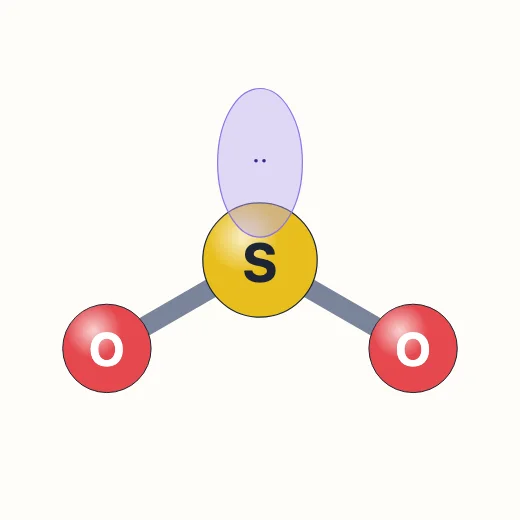
| Property | SO2 |
|---|---|
| Valence electrons | 18 |
| Central atom | S |
| AXE | AX2E |
| Electron geometry | trigonal planar |
| Molecular geometry | bent |
| Bond angle | <120° ideal; ≈ 119° measured |
| Hybridization | sp2 |
| Polarity | Polar |
Two ways to draw it
The octet-rule version has one S=O double bond and one S–O single bond, which puts +1 on sulfur and −1 on the single-bonded oxygen, and it needs two resonance forms. The other version gives sulfur two double bonds so every formal charge is zero, but sulfur then holds 10 electrons. This page shows both views.
Which version exams expect
Many high-school and AP-style answer keys accept either drawing as long as the electron count is right. Courses that stress the octet rule usually want the two resonance forms, while courses that teach formal-charge minimizing often want the two-double-bond form, so check your textbook. The VSEPR answer is identical either way: two bonding domains and one lone pair on S.
Why the angle is just under 120°
Three domains on sulfur give a trigonal planar arrangement with 120° spacing. The lone pair squeezes the two S–O bonds only slightly, so the measured angle stays close to 119°, much wider than the 104.5° of water.
Bent means polar
Each S–O bond has an electronegativity difference of 0.86, and the lone pair sits on one side of sulfur. The two bond dipoles point partly the same way and do not cancel, so SO2 is polar, unlike the straight CO2.
Common mistakes
Watch out
- Treating SO2 like CO2 and calling it linear: count the electrons first, because the 2 extra valence electrons become a lone pair on sulfur that bends the molecule.
- Leaving the lone pair off sulfur after drawing two double bonds: 18 electrons minus 16 for the bonds and oxygen lone pairs leaves 2, and they must go on S.
Practice questions
Try each one before opening the answer.
In the octet-rule structure of SO2, what are the formal charges on each atom?
Sulfur is +1, the double-bonded oxygen is 0 and the single-bonded oxygen is −1. They add to zero, matching a neutral molecule.
Why does SO2 show resonance?
In the octet structure the double bond can be drawn to either oxygen, giving two equivalent forms. The real molecule is an average of them, so both S–O bonds have the same length.
Give the electron geometry, molecular geometry and hybridization of S in SO2.
Trigonal planar electron geometry, bent molecular geometry and sp2 sulfur, because sulfur has three domains: two bonds and one lone pair.
SO2 compared with similar molecules
| Molecule | Valence e⁻ | AXE | Shape | Bond angle | Polarity |
|---|---|---|---|---|---|
| SO2 | 18 e⁻ | AX2E | bent | ≈ 119° | polar |
| O3 | 18 e⁻ | AX2E | bent | 116.8° | polar |
| CO2 | 16 e⁻ | AX2 | linear | 180° | nonpolar |
| NO2− | 18 e⁻ | AX2E | bent | ≈ 115° | ion (net charge) |
Where you meet it
SO2 comes from volcanoes and coal-burning power plants, forms acid rain, and is added in small amounts to wine and dried fruit as a preservative.
Shape rules: OpenStax Chemistry 2e §7.6.