Hydrogen sulfide is the toxic gas behind the smell of rotten eggs. It has the same Lewis pattern as water, but its bond angle is about 12° smaller, which makes it a favourite exam comparison.
H2S Lewis structure, step by step
- Count valence electrons: 2 × H (1) + S (6) = 8 electrons.
- Central atom: S. Sulfur is the least electronegative atom other than hydrogen (2.58), so it goes in the middle.
- Bond each outer atom to S (2 bonds = 4 electrons), then complete the outer atoms (hydrogen needs no lone pairs). That uses 4 electrons.
- 8 − 4 = 4 electrons left for S: 2 lone pairs.
- Electron domains on S: 2 bonded + 2 lone = 4 (steric number). A double or triple bond still counts as one domain.
- AX2E2: tetrahedral electron geometry, bent molecular geometry, sp3 hybridization.
Shape, bond angle and hybridization
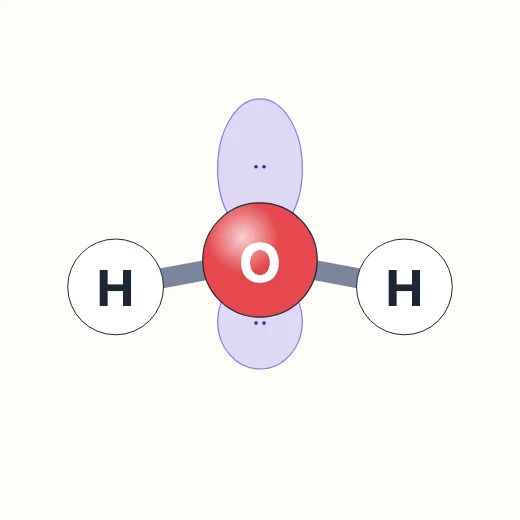
| Property | H2S |
|---|---|
| Valence electrons | 8 |
| Central atom | S |
| AXE | AX2E2 |
| Electron geometry | tetrahedral |
| Molecular geometry | bent |
| Bond angle | <109.5° ideal; 92.1° measured |
| Hybridization | sp3 |
| Polarity | Polar |
Same pattern as water
Sulfur sits directly below oxygen in group 16, so H2S and H2O both have two bonds and two lone pairs on the central atom. Both are AX2E2, with a tetrahedral electron geometry and a bent shape.
Why 92.1° is so far below 109.5°
Sulfur is larger than oxygen and its bonds are longer, so the two bonding pairs are far apart and barely push on each other. The lone pairs dominate and close the angle to 92.1°. An angle that close to 90° suggests sulfur bonds mostly through its p orbitals; sp3 is the VSEPR bookkeeping answer exams expect.
Only weakly polar
Sulfur (2.58) and hydrogen (2.20) differ by just 0.38 in electronegativity, so each S–H bond is close to nonpolar. The bent shape still keeps the dipoles from cancelling, but the overall dipole is much smaller than water's.
A gas, while water is a liquid
Water molecules hydrogen-bond strongly because O–H bonds are very polar. S–H bonds are not polar enough for that, so H2S boils far below room temperature even though each molecule is heavier than a water molecule.
Common mistakes
Watch out
- Copying water's 104.5° for H2S; the measured angle is 92.1°, because the larger sulfur atom lets the lone pairs squeeze the bonds much more.
- Giving sulfur extra lone pairs or an expanded octet; with only 8 valence electrons, sulfur gets two bonds and two lone pairs, exactly an octet.
Practice questions
Try each one before opening the answer.
How many valence electrons and lone pairs does H2S have?
8 valence electrons: 4 in the two S–H bonds and 4 as two lone pairs on sulfur. The hydrogens carry no lone pairs.
Which has the larger bond angle, H2O or H2S, and why?
H2O, at 104.5° versus 92.1°. Oxygen is smaller and more electronegative, so its bonding pairs stay close to the centre and repel each other more, resisting the lone pairs' squeeze.
Is H2S more or less polar than H2O? Explain.
Less polar. Both are bent, but the S–H bond (ΔEN 0.38) is far less polar than O–H, so the net dipole is smaller.
H2S compared with similar molecules
| Molecule | Valence e⁻ | AXE | Shape | Bond angle | Polarity |
|---|---|---|---|---|---|
| H2S | 8 e⁻ | AX2E2 | bent | 92.1° | polar |
| H2O | 8 e⁻ | AX2E2 | bent | 104.5° | polar |
| OF2 | 20 e⁻ | AX2E2 | bent | 103° | polar |
| CS2 | 16 e⁻ | AX2 | linear | 180° | nonpolar |
Where you meet it
H2S comes from volcanic vents, sewers and rotting organic matter, where bacteria break down sulfur-containing proteins without oxygen.
Shape rules: OpenStax Chemistry 2e §7.6.