Oxygen difluoride is a pale yellow, poisonous gas and a powerful oxidizer. It is one of the few molecules where oxygen is the central atom, because the only element that out-pulls oxygen for electrons is fluorine.
OF2 Lewis structure, step by step
- Count valence electrons: O (6) + 2 × F (7) = 20 electrons.
- Central atom: O. Oxygen is the least electronegative atom other than hydrogen (3.44), so it goes in the middle.
- Bond each outer atom to O (2 bonds = 4 electrons), then complete the outer atoms (2 × 6 electrons as lone pairs). That uses 16 electrons.
- 20 − 16 = 4 electrons left for O: 2 lone pairs.
- Electron domains on O: 2 bonded + 2 lone = 4 (steric number). A double or triple bond still counts as one domain.
- AX2E2: tetrahedral electron geometry, bent molecular geometry, sp3 hybridization.
Shape, bond angle and hybridization
| Property | OF2 |
|---|---|
| Valence electrons | 20 |
| Central atom | O |
| AXE | AX2E2 |
| Electron geometry | tetrahedral |
| Molecular geometry | bent |
| Bond angle | <109.5° ideal; 103° measured |
| Hybridization | sp3 |
| Polarity | Polar |
Oxygen in the middle for once
Oxygen is usually an outer atom, but fluorine (3.98) is even more electronegative than oxygen (3.44) and forms only one bond. So the fluorines go outside and oxygen takes the centre. It also gives oxygen a positive oxidation state here, +2, instead of its usual −2.
Built like a water molecule
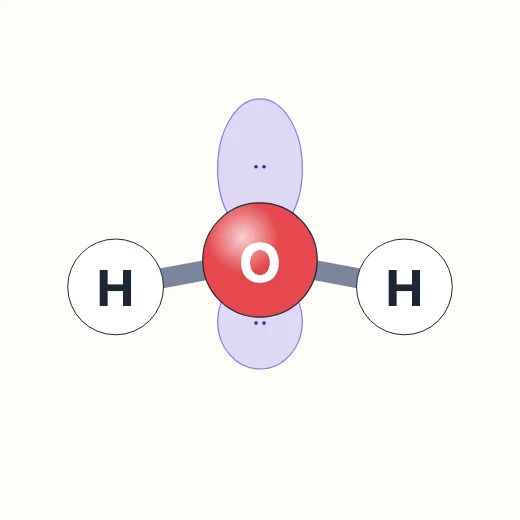
OF2 has the same AX2E2 pattern as H2O: two bonds and two lone pairs give a tetrahedral electron geometry and a bent molecule. The two lone pairs press the bonds together, so the angle drops below 109.5°.
Why 103° and not water's 104.5°
Fluorine pulls the bonding electrons away from oxygen, so the bond pairs sit farther from the central atom and repel each other less. Oxygen's lone pairs can then squeeze the bonds slightly more than in water, where the bond pairs stay closer to O.
Polar, but only weakly
In water the oxygen end is negative, but in OF2 the fluorine ends are. The O–F bond dipoles (ΔEN 0.54) point away from oxygen and partly work against the lone pairs' contribution, so OF2 ends up only weakly polar.
Common mistakes
Watch out
- Putting fluorine in the centre because of how the formula looks; fluorine forms only one bond, so it is always an outer atom and oxygen must be central.
- Calling OF2 linear because it has two outer atoms like CO2; oxygen's two lone pairs make four domains, which bends the molecule.
Practice questions
Try each one before opening the answer.
How many lone pairs does the whole OF2 molecule have?
8: two on oxygen and three on each fluorine. That is 16 lone-pair electrons plus 4 bonding electrons, 20 in total.
Rank H2O and OF2 by bond angle and explain.
H2O (104.5°) is larger than OF2 (103°). Fluorine draws the bonding electrons away from O, which lets oxygen's lone pairs push the bonds closer together.
What is the hybridization of O in OF2?
sp3: a steric number of 4 from two bonds and two lone pairs.
OF2 compared with similar molecules
| Molecule | Valence e⁻ | AXE | Shape | Bond angle | Polarity |
|---|---|---|---|---|---|
| OF2 | 20 e⁻ | AX2E2 | bent | 103° | polar |
| H2O | 8 e⁻ | AX2E2 | bent | 104.5° | polar |
| H2S | 8 e⁻ | AX2E2 | bent | 92.1° | polar |
| ClO2− | 20 e⁻ | AX2E2 | bent | <109.5° | ion (net charge) |
Where you meet it
OF2 was once tested as an oxidizer for rocket fuel; students usually meet it in inorganic chemistry as the compound that gives oxygen a positive oxidation state.
Shape rules: OpenStax Chemistry 2e §7.6.