Nitrogen dioxide is the reddish-brown gas in city smog. With an odd number of electrons it cannot give every atom an octet, which makes it the textbook example of a free radical.
NO2 Lewis structure, step by step
- Count valence electrons: N (5) + 2 × O (6) = 17 electrons.
- Central atom: N. Nitrogen is the least electronegative atom other than hydrogen (3.04), so it goes in the middle.
- Bond each outer atom to N (2 bonds = 4 electrons), then complete the outer atoms (2 × 6 electrons as lone pairs). That uses 16 electrons.
- 17 − 16 = 1 electron left for N: one unpaired electron (a radical; it still counts as a domain).
- That leaves N with only 5 electrons, short of an octet. Move one lone pair from the outer atom into the bond: one N=O double bond. Now N has 7 (the odd electron stays unpaired).
- Electron domains on N: 2 bonded + 1 lone = 3 (steric number). A double or triple bond still counts as one domain.
- AX2E: trigonal planar electron geometry, bent molecular geometry, sp2 hybridization.
Shape, bond angle and hybridization
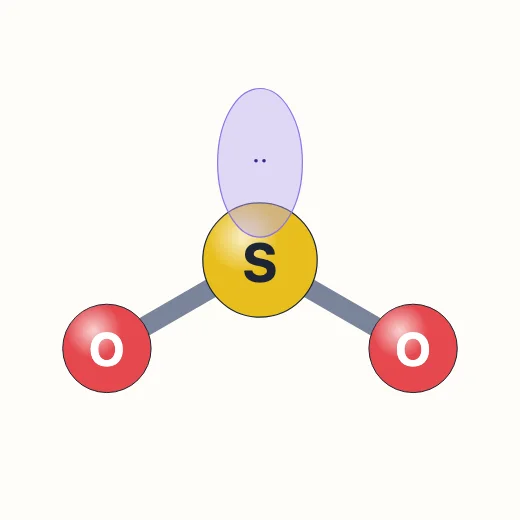
| Property | NO2 |
|---|---|
| Valence electrons | 17 |
| Central atom | N |
| AXE | AX2E |
| Electron geometry | trigonal planar |
| Molecular geometry | bent |
| Bond angle | <120° ideal; 134.3° measured |
| Hybridization | sp2 |
| Polarity | Polar |
An odd electron count
Nitrogen brings 5 and the two oxygens bring 12, for 17 valence electrons. After the bonds and the oxygen lone pairs are placed, a single electron is left over, so nitrogen ends up with only 7 electrons around it.
Two resonance forms
One N–O bond is drawn double and the other single, and the double bond can go to either oxygen. The real molecule is an average of the two, so both N–O bonds are the same length.
Why the angle is wider than 120°
The unpaired electron still counts as a domain, giving a trigonal planar arrangement and a bent shape. But one electron repels much less than a full lone pair, so the O–N–O angle opens to about 134°, wider than 120° rather than narrower. Compare NO2−, with a full lone pair, at about 115°, and NO2+, with none, at 180°.
The radical pairs up
The lone electron makes NO2 reactive. Two molecules join through their nitrogen atoms to form colorless N2O4, which is why a sealed tube of the brown gas turns paler when it is cooled.
Common mistakes
Watch out
- Forcing an octet onto nitrogen by adding an electron: NO2 really has 17 electrons, so leave one unpaired; adding one turns it into the nitrite ion, NO2−.
- Predicting an angle below 120° as for SO2: a single electron pushes less than a lone pair, so NO2 opens out to about 134°.
Practice questions
Try each one before opening the answer.
How many valence electrons does NO2 have, and what does that tell you about its Lewis structure?
17. An odd total means one electron must stay unpaired, so at least one atom (nitrogen) cannot have an octet.
Put NO2+, NO2 and NO2− in order of increasing O–N–O angle.
NO2− (about 115°) < NO2 (about 134°) < NO2+ (180°). The angle widens as the non-bonding electrons on nitrogen drop from a pair to one electron to none.
What is the hybridization of nitrogen in NO2?
sp2. Nitrogen has three domains: two bonds and the unpaired electron.
NO2 compared with similar molecules
| Molecule | Valence e⁻ | AXE | Shape | Bond angle | Polarity |
|---|---|---|---|---|---|
| NO2 | 17 e⁻ | AX2E | bent | 134.3° | polar |
| NO2− | 18 e⁻ | AX2E | bent | ≈ 115° | ion (net charge) |
| SO2 | 18 e⁻ | AX2E | bent | ≈ 119° | polar |
| O3 | 18 e⁻ | AX2E | bent | 116.8° | polar |
Where you meet it
NO2 forms in car engines and power plants, gives smog its brown tint, and shows up in equilibrium labs as the NO2/N2O4 color change.
Shape rules: OpenStax Chemistry 2e §7.6.