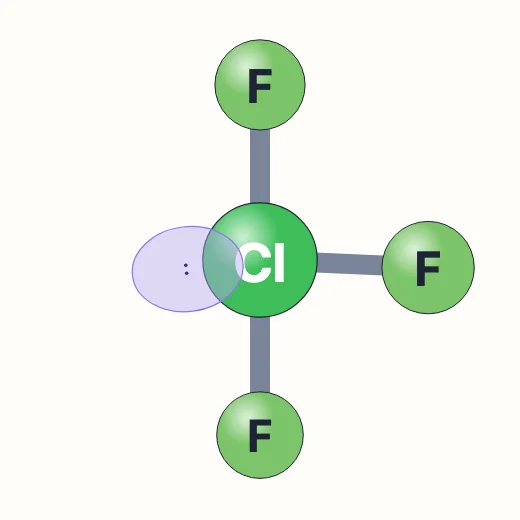
Chlorine trifluoride is one of the most aggressive chemicals known: it can ignite materials such as sand and glass that are normally thought of as fireproof. Its structure is a lone-pair puzzle, because two lone pairs share a trigonal bipyramid with three fluorines and the result looks like a letter T.
ClF3 Lewis structure, step by step
- Count valence electrons: Cl (7) + 3 × F (7) = 28 electrons.
- Central atom: Cl. Chlorine is the least electronegative atom other than hydrogen (3.16), so it goes in the middle.
- Bond each outer atom to Cl (3 bonds = 6 electrons), then complete the outer atoms (3 × 6 electrons as lone pairs). That uses 24 electrons.
- 28 − 24 = 4 electrons left for Cl: 2 lone pairs.
- Electron domains on Cl: 3 bonded + 2 lone = 5 (steric number). A double or triple bond still counts as one domain.
- AX3E2: trigonal bipyramidal electron geometry, T-shaped molecular geometry, sp3d hybridization.
Shape, bond angle and hybridization
| Property | ClF3 |
|---|---|
| Valence electrons | 28 |
| Central atom | Cl |
| AXE | AX3E2 |
| Electron geometry | trigonal bipyramidal |
| Molecular geometry | T-shaped |
| Bond angle | <90° ideal; 87.5° measured |
| Hybridization | sp3d |
| Polarity | Polar |
Why chlorine is in the middle
Both elements are halogens, but chlorine (3.16) is less electronegative than fluorine, and fluorine almost never forms more than one bond. So chlorine sits in the centre and the three fluorines hang off it.
Both lone pairs go equatorial
Chlorine has five domains: three bonds and two lone pairs. Lone pairs take equatorial positions, where they have fewer 90° neighbours; with both of them there, the fluorines end up as one equatorial and two axial. Draw that and you get the T.
A slightly bent T: 87.5° instead of 90°
The two lone pairs push the axial fluorines back toward the equatorial one, so the measured F(axial)–Cl–F(equatorial) angle is 87.5°, not 90°. As a result the axial F–Cl–F line is not quite a straight 180° either; it bends a few degrees away from the lone pairs.
Polar and lopsided
The three Cl–F bonds (ΔEN 0.82) do not point in balanced directions: the stem of the T has no partner on the opposite side. Together with the two lone pairs crowded on one side, that gives ClF3 a net dipole.
Common mistakes
Watch out
- Calling ClF3 trigonal planar like BF3; chlorine has two lone pairs that boron lacks, so its steric number is 5, not 3.
- Putting a lone pair in an axial position; in a five-domain molecule both lone pairs belong in the equatorial plane, which is exactly what produces the T.
Practice questions
Try each one before opening the answer.
How many electrons surround the central Cl in ClF3?
10: three bonding pairs (6 electrons) plus two lone pairs (4 electrons), an expanded octet that period 3 chlorine can hold.
Why is the F–Cl–F angle in ClF3 measured at 87.5° rather than 90°?
The two equatorial lone pairs repel bonding pairs more strongly than bonds repel each other, so they push the axial fluorines slightly toward the equatorial fluorine.
What hybridization does Cl use in ClF3?
sp3d, because five electron domains (three bonds and two lone pairs) need five hybrid orbitals.
ClF3 compared with similar molecules
| Molecule | Valence e⁻ | AXE | Shape | Bond angle | Polarity |
|---|---|---|---|---|---|
| ClF3 | 28 e⁻ | AX3E2 | T-shaped | 87.5° | polar |
| BrF3 | 28 e⁻ | AX3E2 | T-shaped | <90° | polar |
| BF3 | 24 e⁻ | AX3 | trigonal planar | 120° | nonpolar |
| SF4 | 34 e⁻ | AX4E | seesaw | F(ax)–S–F(ax) 173.1°, F(eq)–S–F(eq) 101.6° | polar |
Where you meet it
ClF3 is used industrially to clean deposits out of semiconductor processing chambers and to make uranium hexafluoride in nuclear fuel processing.
Shape rules: OpenStax Chemistry 2e §7.6.