BrF3 is an interhalogen in which bromine holds ten electrons: three bonding pairs and two lone pairs. The way those five domains share a trigonal bipyramid produces a T shape, one of the less obvious VSEPR results.
BrF3 Lewis structure, step by step
- Count valence electrons: Br (7) + 3 × F (7) = 28 electrons.
- Central atom: Br. Bromine is the least electronegative atom other than hydrogen (2.96), so it goes in the middle.
- Bond each outer atom to Br (3 bonds = 6 electrons), then complete the outer atoms (3 × 6 electrons as lone pairs). That uses 24 electrons.
- 28 − 24 = 4 electrons left for Br: 2 lone pairs.
- Electron domains on Br: 3 bonded + 2 lone = 5 (steric number). A double or triple bond still counts as one domain.
- AX3E2: trigonal bipyramidal electron geometry, T-shaped molecular geometry, sp3d hybridization.
Shape, bond angle and hybridization
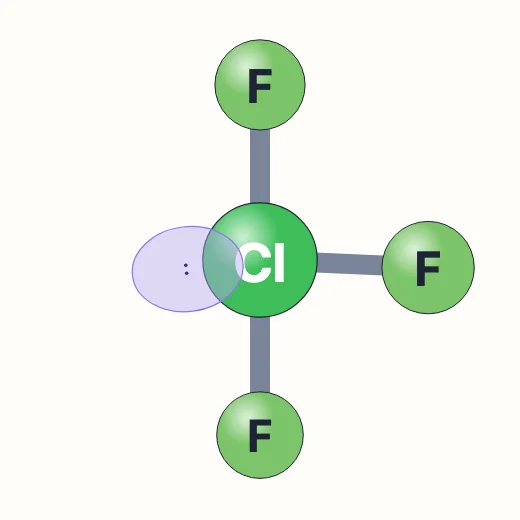
| Property | BrF3 |
|---|---|
| Valence electrons | 28 |
| Central atom | Br |
| AXE | AX3E2 |
| Electron geometry | trigonal bipyramidal |
| Molecular geometry | T-shaped |
| Bond angle | <90° |
| Hybridization | sp3d |
| Polarity | Polar |
Why bromine can hold ten electrons
Bromine is in period 4, so unlike fluorine it can carry more than an octet. After the three F atoms take their bonds and lone pairs, 4 electrons are left over, and they sit on bromine as two lone pairs.
Lone pairs choose the equator
In a trigonal bipyramid an equatorial spot has only two neighbors at 90°, while an axial spot has three. Both lone pairs therefore take equatorial positions, leaving two axial fluorines and one equatorial fluorine: a T.
A slightly bent T
The lone pairs push the two axial fluorines back toward the equatorial one, so the F–Br–F angles are about 86° instead of 90°. The axial F–Br–F line is therefore a little short of a straight 180°.
Polar and very reactive
Nothing in the T shape balances the equatorial bond against the lone-pair side, so the molecule is polar. Liquid BrF3 even ionizes slightly into BrF2+ and BrF4−, and it is one of the most aggressive fluorinating agents known.
Common mistakes
Watch out
- Calling BrF3 trigonal planar like BF3; bromine has two lone pairs that boron lacks, so the electron geometry is trigonal bipyramidal.
- Putting the lone pairs in axial positions, which would leave the fluorines in a flat triangle; lone pairs go equatorial, giving the T.
Practice questions
Try each one before opening the answer.
Where do the lone pairs on Br go in BrF3, and why?
Both go equatorial. Equatorial positions have fewer 90° neighbors, so lone pairs there feel the least repulsion.
What are the steric number and hybridization of Br in BrF3?
Steric number 5 (3 bonds + 2 lone pairs), so the hybridization is sp3d.
BF3 and BrF3 both have three F atoms. Why are their shapes different?
BF3 has 24 valence electrons and no lone pair on B, so it is trigonal planar. BrF3 has 28, which puts two lone pairs on Br and makes five domains, giving a T shape.
BrF3 compared with similar molecules
| Molecule | Valence e⁻ | AXE | Shape | Bond angle | Polarity |
|---|---|---|---|---|---|
| BrF3 | 28 e⁻ | AX3E2 | T-shaped | <90° | polar |
| ClF3 | 28 e⁻ | AX3E2 | T-shaped | 87.5° | polar |
| BF3 | 24 e⁻ | AX3 | trigonal planar | 120° | nonpolar |
| XeF2 | 22 e⁻ | AX2E3 | linear | 180° | nonpolar |
Where you meet it
Bromine trifluoride appears in inorganic chemistry as a powerful fluorinating agent and as an unusual self-ionizing solvent.
Structure data: OpenStax Chemistry 2e, §7.6 Molecular Structure and Polarity. Shape rules: OpenStax Chemistry 2e §7.6.