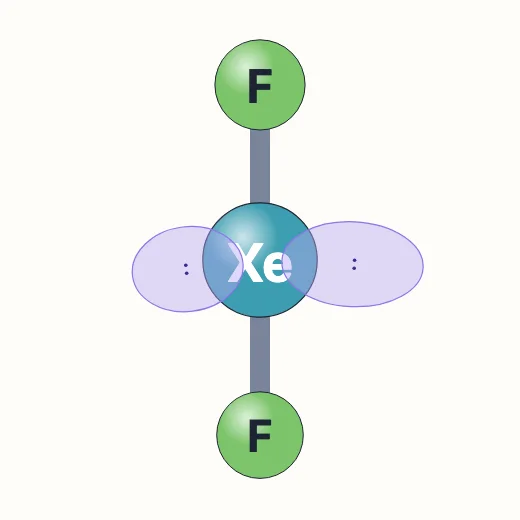
Xenon difluoride is a white crystalline solid and one of the easiest noble-gas compounds to make and handle. Its structure surprises most students: five electron domains, three of them lone pairs, and yet the molecule is a straight line.
XeF2 Lewis structure, step by step
- Count valence electrons: Xe (8) + 2 × F (7) = 22 electrons.
- Central atom: Xe. Xenon is the least electronegative atom other than hydrogen (2.6), so it goes in the middle.
- Bond each outer atom to Xe (2 bonds = 4 electrons), then complete the outer atoms (2 × 6 electrons as lone pairs). That uses 16 electrons.
- 22 − 16 = 6 electrons left for Xe: 3 lone pairs.
- Electron domains on Xe: 2 bonded + 3 lone = 5 (steric number). A double or triple bond still counts as one domain.
- AX2E3: trigonal bipyramidal electron geometry, linear molecular geometry, sp3d hybridization.
Shape, bond angle and hybridization
| Property | XeF2 |
|---|---|
| Valence electrons | 22 |
| Central atom | Xe |
| AXE | AX2E3 |
| Electron geometry | trigonal bipyramidal |
| Molecular geometry | linear |
| Bond angle | 180° |
| Hybridization | sp3d |
| Polarity | Nonpolar |
Three lone pairs around the equator
Xenon's five domains form a trigonal bipyramid. All three lone pairs go into the equatorial triangle, where they are 120° from one another. That leaves the two fluorines on the axis, directly opposite each other.
Linear, but not like CO2
CO2 is linear because carbon has only two domains. XeF2 is linear because its three lone pairs surround the F–Xe–F axis evenly and push equally from every side. Same shape name, different electron geometry: linear for CO2, trigonal bipyramidal for XeF2.
Ten electrons on xenon
Two bonds and three lone pairs put 10 electrons around xenon, an expanded octet in the usual drawing. The 3-centre-4-electron model describes the F–Xe–F unit as one bond spread over all three atoms, which fits the fact that the two Xe–F bonds are identical.
Nonpolar despite polar bonds
Each Xe–F bond is quite polar (ΔEN 1.38), but the two point in exactly opposite directions and cancel. The symmetric ring of lone pairs adds no net dipole of its own, so XeF2 is nonpolar.
Common mistakes
Watch out
- Placing lone pairs on the axis and getting a bent or T-shaped answer; in a trigonal bipyramid, lone pairs fill the three equatorial positions first.
- Seeing 180° and writing sp hybridization; a steric number of 5 means sp3d, even though the atoms form a straight line.
Practice questions
Try each one before opening the answer.
How many electrons are left on Xe after bonding both F atoms and completing their octets?
6. The molecule has 22 electrons, and 16 are used by the two bonds and the fluorines' lone pairs, leaving three lone pairs on Xe.
Why do all three lone pairs in XeF2 sit in equatorial positions?
An equatorial position has only two 90° neighbours, compared with three for an axial one. Putting the lone pairs there keeps the strong 90° lone-pair repulsions to a minimum.
Compare the electron geometry and molecular geometry of XeF2.
Electron geometry: trigonal bipyramidal, from 5 domains. Molecular geometry: linear, because only the two axial positions hold atoms.
XeF2 compared with similar molecules
| Molecule | Valence e⁻ | AXE | Shape | Bond angle | Polarity |
|---|---|---|---|---|---|
| XeF2 | 22 e⁻ | AX2E3 | linear | 180° | nonpolar |
| XeF4 | 36 e⁻ | AX4E2 | square planar | 90° | nonpolar |
| I3− | 22 e⁻ | AX2E3 | linear | 180° | ion (net charge) |
| CO2 | 16 e⁻ | AX2 | linear | 180° | nonpolar |
Where you meet it
XeF2 is sold as a fluorinating reagent and is used as a gas in microfabrication to etch silicon.
Structure data: OpenStax Chemistry 2e, §7.6 Molecular Structure and Polarity. Shape rules: OpenStax Chemistry 2e §7.6.