Triiodide forms when an iodide ion latches onto an I2 molecule, which is why iodine dissolves so well in potassium iodide solution. Its central iodine carries three lone pairs and two bonds, yet the ion is perfectly straight.
I3− Lewis structure, step by step
- Count valence electrons: 3 × I (7) + 1 for the 1− charge = 22 electrons.
- Central atom: I. All atoms are iodine; one sits in the middle.
- Bond each outer atom to I (2 bonds = 4 electrons), then complete the outer atoms (2 × 6 electrons as lone pairs). That uses 16 electrons.
- 22 − 16 = 6 electrons left for I: 3 lone pairs.
- Electron domains on I: 2 bonded + 3 lone = 5 (steric number). A double or triple bond still counts as one domain.
- AX2E3: trigonal bipyramidal electron geometry, linear molecular geometry, sp3d hybridization.
Shape, bond angle and hybridization
| Property | I3− |
|---|---|
| Valence electrons | 22 |
| Central atom | I |
| AXE | AX2E3 |
| Electron geometry | trigonal bipyramidal |
| Molecular geometry | linear |
| Bond angle | 180° |
| Hybridization | sp3d |
| Polarity | Ion (net charge) |
Ten electrons on the middle iodine
The two outer iodines take 16 electrons (bonds plus lone pairs), leaving 22 − 16 = 6 for the central atom as three lone pairs. That gives the middle iodine 10 electrons, an expanded octet a large period-5 atom can manage.
Three lone pairs around the waist
The five domains form a trigonal bipyramid. All three lone pairs take the roomier equatorial positions, 120° apart, and the two bonded iodines sit at the axial positions directly opposite each other, so the ion is linear at 180°.
Where the minus charge goes
In the Lewis structure the formal charge of −1 sits on the central iodine and the outer two are 0. Studies of the real ion place most of that extra charge on the two outer iodines instead, shared equally because the ion is symmetric.
Same pattern as XeF2
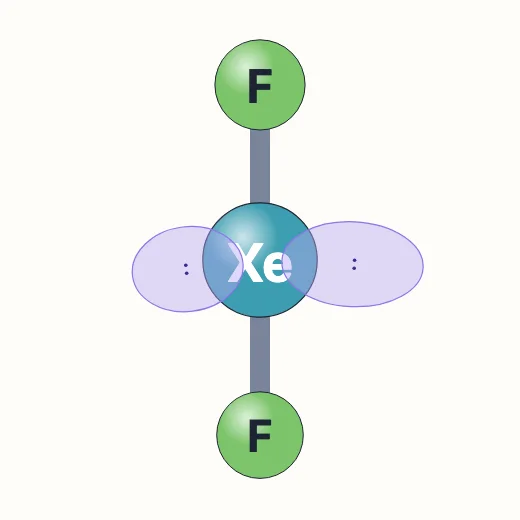
XeF2 also has 22 valence electrons and an AX2E3 central atom, so it is linear for exactly the same reason. If you can draw one, you can draw the other.
Common mistakes
Watch out
- Calling I3− bent because the central atom has lone pairs; with all three lone pairs on the equator, the two bonds end up exactly opposite each other.
- Using 21 electrons by forgetting the 1− charge, which leaves an odd electron on the central iodine; add 1 for the charge to get 22.
Practice questions
Try each one before opening the answer.
What is the steric number of the central I in I3−, and what is its electron geometry?
5 (2 bonds + 3 lone pairs), so the electron geometry is trigonal bipyramidal.
Why are the lone pairs in I3− placed equatorially?
An equatorial position has only two neighbors at 90°, so lone pairs there feel less repulsion. With all three equatorial, the axial spots are left for the two bonds.
Find the formal charge on each iodine in I3−.
Each outer I: 7 − 6 − 1 = 0. Central I: 7 − 6 − 2 = −1, which matches the ion's overall charge.
I3− compared with similar molecules
| Molecule | Valence e⁻ | AXE | Shape | Bond angle | Polarity |
|---|---|---|---|---|---|
| I3− | 22 e⁻ | AX2E3 | linear | 180° | ion (net charge) |
| XeF2 | 22 e⁻ | AX2E3 | linear | 180° | nonpolar |
| CO2 | 16 e⁻ | AX2 | linear | 180° | nonpolar |
| BrF3 | 28 e⁻ | AX3E2 | T-shaped | <90° | polar |
Where you meet it
Triiodide is the active species in Lugol's iodine and in the iodine solutions used for the blue-black starch test in biology labs.
Structure data: OpenStax Chemistry 2e, §7.6 Molecular Structure and Polarity. Shape rules: OpenStax Chemistry 2e §7.6.