Boron trifluoride is the go-to example of a central atom that settles for fewer than eight electrons. The empty space on boron controls both its structure and its chemistry.
BF3 Lewis structure, step by step
- Count valence electrons: B (3) + 3 × F (7) = 24 electrons.
- Central atom: B. Boron is the least electronegative atom other than hydrogen (2.04), so it goes in the middle.
- Bond each outer atom to B (3 bonds = 6 electrons), then complete the outer atoms (3 × 6 electrons as lone pairs). That uses 24 electrons.
- 24 − 24 = 0 electrons left for B, so it has no lone pairs.
- Electron domains on B: 3 bonded + 0 lone = 3 (steric number). A double or triple bond still counts as one domain.
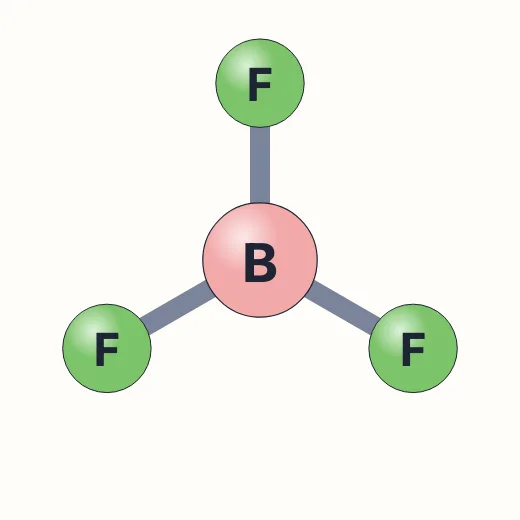
- AX3: trigonal planar electron geometry, trigonal planar molecular geometry, sp2 hybridization.
Shape, bond angle and hybridization
| Property | BF3 |
|---|---|
| Valence electrons | 24 |
| Central atom | B |
| AXE | AX3 |
| Electron geometry | trigonal planar |
| Molecular geometry | trigonal planar |
| Bond angle | 120° |
| Hybridization | sp2 |
| Polarity | Nonpolar |
Boron stops at six
Boron has only 3 valence electrons, so it forms three B–F bonds and runs out. Each fluorine keeps three lone pairs, and boron is left with 6 electrons, an incomplete octet that is still the accepted Lewis structure.
Why not a B=F double bond?
You could move a fluorine lone pair in to make a B=F double bond and give boron an octet. That would put a +1 formal charge on fluorine, the most electronegative element, so the all-single-bond structure with zero formal charges is preferred.
Flat and nonpolar
Three bonding domains and no lone pair spread to 120° in a flat triangle. The B–F bonds are very polar (ΔEN 1.94), but their dipoles cancel in the symmetric shape, so BF3 has no net dipole.
An electron-pair acceptor
The empty p orbital on boron makes BF3 a Lewis acid. It takes the lone pair on ammonia to form F3B–NH3, and in that adduct boron has four domains and becomes tetrahedral.
Common mistakes
Watch out
- Adding electrons or a double bond so boron has an octet: boron is a known exception and is drawn with only 6 electrons.
- Calling BF3 trigonal pyramidal like NH3: boron has no lone pair, so the molecule is flat.
Practice questions
Try each one before opening the answer.
How many electrons surround boron in BF3?
Six, from three B–F single bonds. Boron has no lone pairs.
BF3 and NH3 both have three outer atoms. Compare their shapes and polarity.
BF3 is trigonal planar and nonpolar because boron has no lone pair. NH3 is trigonal pyramidal and polar because nitrogen's lone pair pushes the bonds down.
What shape does boron take after BF3 reacts with NH3?
Tetrahedral. Nitrogen's lone pair forms a fourth bond to boron, giving it four domains and sp3 hybridization.
BF3 compared with similar molecules
| Molecule | Valence e⁻ | AXE | Shape | Bond angle | Polarity |
|---|---|---|---|---|---|
| BF3 | 24 e⁻ | AX3 | trigonal planar | 120° | nonpolar |
| BCl3 | 24 e⁻ | AX3 | trigonal planar | 120° | nonpolar |
| NH3 | 8 e⁻ | AX3E | trigonal pyramidal | 106.7° | polar |
| BH3 | 6 e⁻ | AX3 | trigonal planar | 120° | nonpolar |
Where you meet it
BF3 is used as a catalyst in organic synthesis, and it is the textbook partner for ammonia when Lewis acids and bases are introduced.
Structure data: OpenStax Chemistry 2e, §7.6 Molecular Structure and Polarity. Shape rules: OpenStax Chemistry 2e §7.6.