Boron trichloride has polar bonds around an electron-poor center, and those two facts explain most of its chemistry. Boron makes three bonds and stops at six electrons, so the molecule is flat, symmetric and eager to grab a lone pair.
BCl3 Lewis structure, step by step
- Count valence electrons: B (3) + 3 × Cl (7) = 24 electrons.
- Central atom: B. Boron is the least electronegative atom other than hydrogen (2.04), so it goes in the middle.
- Bond each outer atom to B (3 bonds = 6 electrons), then complete the outer atoms (3 × 6 electrons as lone pairs). That uses 24 electrons.
- 24 − 24 = 0 electrons left for B, so it has no lone pairs.
- Electron domains on B: 3 bonded + 0 lone = 3 (steric number). A double or triple bond still counts as one domain.
- AX3: trigonal planar electron geometry, trigonal planar molecular geometry, sp2 hybridization.
Shape, bond angle and hybridization
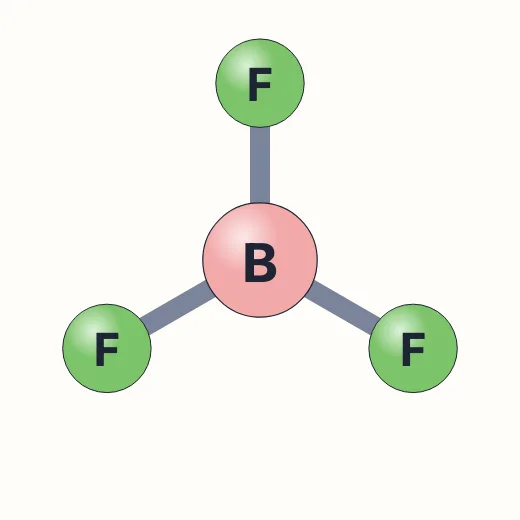
| Property | BCl3 |
|---|---|
| Valence electrons | 24 |
| Central atom | B |
| AXE | AX3 |
| Electron geometry | trigonal planar |
| Molecular geometry | trigonal planar |
| Bond angle | 120° |
| Hybridization | sp2 |
| Polarity | Nonpolar |
Why not a B=Cl double bond?
You could move a chlorine lone pair into a double bond to give boron an octet, but that would put −1 on boron and +1 on chlorine, a strongly electronegative atom. The structure with three single bonds and zero formal charge on every atom is the one textbooks use.
Polar bonds that cancel
Each B–Cl bond is clearly polar (ΔEN 1.12), with chlorine pulling electron density outward. In a flat triangle the three pulls are 120° apart and add to zero, so BCl3 has no net dipole.
A Lewis acid at work
The empty p orbital on boron accepts lone pairs from donors such as ammonia or a chloride ion. With Cl− it forms BCl4−, and boron switches from trigonal planar to tetrahedral as it gains a fourth domain.
Fumes in moist air
Water attacks the electron-poor boron, so BCl3 reacts vigorously with moisture to give boric acid and hydrogen chloride. That is why it is stored dry and fumes when a bottle is opened in humid air.
Common mistakes
Watch out
- Drawing a lone pair on boron to make it look like PCl3; all 24 electrons are already used by the three bonds and the chlorine lone pairs.
- Saying BCl3 is polar because each B–Cl bond is polar; the symmetric triangle cancels the bond dipoles.
Practice questions
Try each one before opening the answer.
How many lone pairs are in the whole BCl3 Lewis structure?
Nine, three on each Cl, and none on boron. 24 − 6 bonding electrons leaves 18, which is 9 pairs.
What is the formal charge on boron in BCl3?
Zero: 3 valence electrons − 0 nonbonding − 3 (half of the 6 bonding electrons) = 0.
How does the geometry at boron change when BCl3 reacts with Cl−?
Boron gains a fourth bonding domain, so it goes from trigonal planar sp2 (120°) to tetrahedral sp3 (109.5°) in BCl4−.
BCl3 compared with similar molecules
| Molecule | Valence e⁻ | AXE | Shape | Bond angle | Polarity |
|---|---|---|---|---|---|
| BCl3 | 24 e⁻ | AX3 | trigonal planar | 120° | nonpolar |
| BF3 | 24 e⁻ | AX3 | trigonal planar | 120° | nonpolar |
| BH3 | 6 e⁻ | AX3 | trigonal planar | 120° | nonpolar |
| PCl3 | 26 e⁻ | AX3E | trigonal pyramidal | 100.3° | polar |
Where you meet it
Boron trichloride is a reactive gas used in plasma etching for microchips and as a Lewis acid reagent in organic synthesis.
Structure data: OpenStax Chemistry 2e, §7.6 Molecular Structure and Polarity. Shape rules: OpenStax Chemistry 2e §7.6.