BH3 is about the simplest molecule that breaks the octet rule. Boron has only three valence electrons to share, so after three B–H bonds it holds six electrons instead of eight, and no rearrangement of lone pairs can fix that.
BH3 Lewis structure, step by step
- Count valence electrons: B (3) + 3 × H (1) = 6 electrons.
- Central atom: B. Boron is the least electronegative atom other than hydrogen (2.04), so it goes in the middle.
- Bond each outer atom to B (3 bonds = 6 electrons), then complete the outer atoms (hydrogen needs no lone pairs). That uses 6 electrons.
- 6 − 6 = 0 electrons left for B, so it has no lone pairs.
- Electron domains on B: 3 bonded + 0 lone = 3 (steric number). A double or triple bond still counts as one domain.
- AX3: trigonal planar electron geometry, trigonal planar molecular geometry, sp2 hybridization.
Shape, bond angle and hybridization
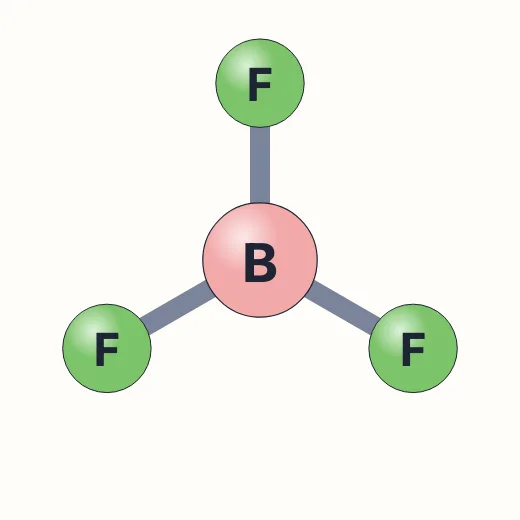
| Property | BH3 |
|---|---|
| Valence electrons | 6 |
| Central atom | B |
| AXE | AX3 |
| Electron geometry | trigonal planar |
| Molecular geometry | trigonal planar |
| Bond angle | 120° |
| Hybridization | sp2 |
| Polarity | Nonpolar |
Six electrons is the right answer
Hydrogen can form only one bond and has no lone pairs to donate, so there is no way to build a double bond to boron. The incomplete octet is not a drawing error. The empty p orbital left on boron, sticking out above and below the plane, is what makes BH3 so reactive.
It hardly exists on its own
Because boron is so electron-hungry, two BH3 units pair up as diborane, B2H6, held together by bridging hydrogens. In the lab, borane is usually handled as a complex with a lone-pair donor such as THF, which fills boron's empty orbital.
Flat and nonpolar
Three bonding domains and no lone pair spread the hydrogens 120° apart in one plane. B–H bonds differ in electronegativity by only 0.16, and the symmetric triangle cancels whatever small dipoles remain, so the molecule is nonpolar.
Opposite of NH3
Swap boron for nitrogen and the same three hydrogens form a pyramid, because nitrogen keeps a lone pair. BH3 accepts a lone pair and NH3 donates one, and together they make the adduct H3N–BH3, ammonia borane.
Common mistakes
Watch out
- Adding a lone pair to boron to reach an octet; only 6 electrons exist and all of them are used in the three B–H bonds.
- Drawing BH3 as a pyramid like NH3; with no lone pair on B, the molecule stays flat.
Practice questions
Try each one before opening the answer.
How many electrons surround boron in the Lewis structure of BH3?
Six, from three B–H bonds of two electrons each. Boron has an incomplete octet.
What hybridization does boron use in BH3, and which orbital stays empty?
sp2 for the three in-plane bonds. One unhybridized 2p orbital, perpendicular to the plane, is left empty.
Why does BH3 behave as a Lewis acid?
Its electron-poor boron and empty p orbital can accept a lone pair from a donor such as NH3 or THF, forming a coordinate bond.
BH3 compared with similar molecules
| Molecule | Valence e⁻ | AXE | Shape | Bond angle | Polarity |
|---|---|---|---|---|---|
| BH3 | 6 e⁻ | AX3 | trigonal planar | 120° | nonpolar |
| BF3 | 24 e⁻ | AX3 | trigonal planar | 120° | nonpolar |
| BCl3 | 24 e⁻ | AX3 | trigonal planar | 120° | nonpolar |
| NH3 | 8 e⁻ | AX3E | trigonal pyramidal | 106.7° | polar |
Where you meet it
Students meet borane in organic chemistry as the BH3·THF reagent used to hydroborate alkenes, and in inorganic chemistry through diborane.
Structure data: OpenStax Chemistry 2e, §7.6 Molecular Structure and Polarity. Shape rules: OpenStax Chemistry 2e §7.6.