Chloroform is methane with three chlorines and one hydrogen left. That single hydrogen is what makes the molecule polar, and it is also the atom chemists swap for deuterium to make the most popular NMR solvent, CDCl3.
CHCl3 Lewis structure, step by step
- Count valence electrons: C (4) + H (1) + 3 × Cl (7) = 26 electrons.
- Central atom: C. Carbon is the least electronegative atom other than hydrogen (2.55), so it goes in the middle.
- Bond each outer atom to C (4 bonds = 8 electrons), then complete the outer atoms (3 × 6 electrons as lone pairs; hydrogen needs no lone pairs). That uses 26 electrons.
- 26 − 26 = 0 electrons left for C, so it has no lone pairs.
- Electron domains on C: 4 bonded + 0 lone = 4 (steric number). A double or triple bond still counts as one domain.
- AX4: tetrahedral electron geometry, tetrahedral molecular geometry, sp3 hybridization.
Shape, bond angle and hybridization
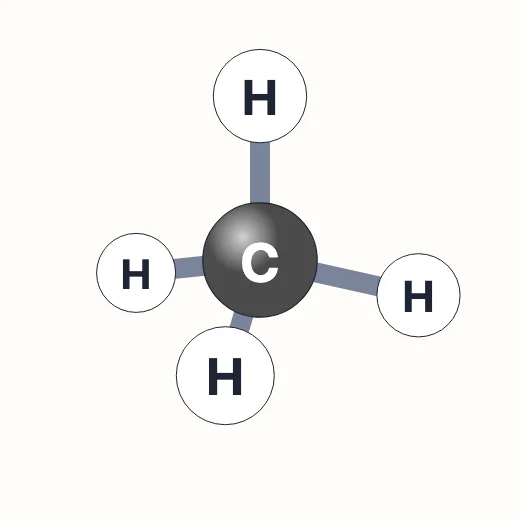
| Property | CHCl3 |
|---|---|
| Valence electrons | 26 |
| Central atom | C |
| AXE | AX4 |
| Electron geometry | tetrahedral |
| Molecular geometry | tetrahedral |
| Bond angle | 109.5° |
| Hybridization | sp3 |
| Polarity | Polar |
One odd atom out
Three C–Cl bond dipoles point out toward the chlorines, while the C–H bond on the fourth corner is nearly nonpolar. Nothing balances the chlorine side, so the net dipole runs along the C–H axis, with the chlorine end partially negative.
More chlorine, smaller dipole
Adding chlorines does not keep raising the dipole. It falls from CH3Cl (about 1.9 D) to CH2Cl2 (about 1.6 D) to CHCl3 (about 1.0 D) and reaches zero in CCl4, because more and more of the C–Cl dipoles point against each other.
One atom away from CCl4
CHCl3 and CCl4 share the same tetrahedral carbon, yet one is polar and the other is not. This pair is a quick check of whether you look at the outer atoms and not just the shape.
Common mistakes
Watch out
- Putting H in the center because it is written first; hydrogen can form only one bond, so carbon is the central atom.
- Saying chloroform is nonpolar because it is tetrahedral; a tetrahedron cancels dipoles only when all four outer atoms match.
Practice questions
Try each one before opening the answer.
Count the valence electrons in CHCl3 and place the lone pairs.
4 + 1 + 21 = 26. Four single bonds use 8, and the other 18 go as three lone pairs on each chlorine.
Which end of a CHCl3 molecule is partially negative?
The chlorine end. Cl is more electronegative than C, so the dipole points from the H corner toward the three chlorines.
Give the electron geometry and hybridization of carbon in CHCl3.
Tetrahedral and sp3: four bonding domains and no lone pair.
CHCl3 compared with similar molecules
| Molecule | Valence e⁻ | AXE | Shape | Bond angle | Polarity |
|---|---|---|---|---|---|
| CHCl3 | 26 e⁻ | AX4 | tetrahedral | 109.5° | polar |
| CH2Cl2 | 20 e⁻ | AX4 | tetrahedral | 109.5° | polar |
| CCl4 | 32 e⁻ | AX4 | tetrahedral | 109.5° | nonpolar |
| CH4 | 8 e⁻ | AX4 | tetrahedral | 109.5° | nonpolar |
Where you meet it
Chloroform was one of the first surgical anesthetics; today it is a lab solvent, and its deuterated form CDCl3 is used for NMR spectra.
Structure data: OpenStax Chemistry 2e, §7.6 Molecular Structure and Polarity. Shape rules: OpenStax Chemistry 2e §7.6.