Dichloromethane is methane with two of its hydrogens swapped for chlorine. The carbon is still an ordinary tetrahedral sp3 center, but having two kinds of neighbor is enough to give the molecule a clear dipole.
CH2Cl2 Lewis structure, step by step
- Count valence electrons: C (4) + 2 × H (1) + 2 × Cl (7) = 20 electrons.
- Central atom: C. Carbon is the least electronegative atom other than hydrogen (2.55), so it goes in the middle.
- Bond each outer atom to C (4 bonds = 8 electrons), then complete the outer atoms (2 × 6 electrons as lone pairs; hydrogen needs no lone pairs). That uses 20 electrons.
- 20 − 20 = 0 electrons left for C, so it has no lone pairs.
- Electron domains on C: 4 bonded + 0 lone = 4 (steric number). A double or triple bond still counts as one domain.
- AX4: tetrahedral electron geometry, tetrahedral molecular geometry, sp3 hybridization.
Shape, bond angle and hybridization
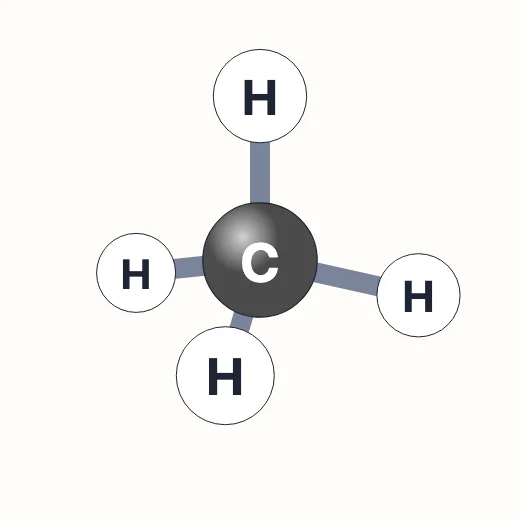
| Property | CH2Cl2 |
|---|---|
| Valence electrons | 20 |
| Central atom | C |
| AXE | AX4 |
| Electron geometry | tetrahedral |
| Molecular geometry | tetrahedral |
| Bond angle | 109.5° |
| Hybridization | sp3 |
| Polarity | Polar |
Flat drawings fool people
Drawn as a flat cross, CH2Cl2 seems to come in two versions, one with the chlorines opposite and one with them side by side. In 3D there is only one: every pair of corners on a tetrahedron is adjacent, so all arrangements are the same molecule. The lack of a second isomer was early evidence that carbon is tetrahedral.
Where the dipole points
Chlorine (3.16) pulls electrons much harder than carbon, while the C–H bonds are only weakly polar. The two C–Cl dipoles add toward the chlorine side and nothing balances them, so the net dipole lies along the line that splits the Cl–C–Cl angle in half.
109.5° is the textbook number
Because the four groups on carbon are not identical, the real angles drift a few degrees away from the ideal tetrahedral value. For VSEPR questions at this level, 109.5° and a tetrahedral shape are the expected answers.
Common mistakes
Watch out
- Calling CH2Cl2 nonpolar because the Cl atoms look opposite in a flat drawing; in a real tetrahedron no two positions are opposite, so the dipoles never cancel.
- Leaving out the chlorine lone pairs; each Cl needs three, and those 12 electrons are what bring the total to 20.
Practice questions
Try each one before opening the answer.
Show how to get 20 valence electrons for CH2Cl2.
C gives 4, two H give 2 and two Cl give 14, so 4 + 2 + 14 = 20. Four single bonds use 8, and the other 12 sit as three lone pairs on each chlorine.
Why is there only one form of CH2Cl2?
Carbon is tetrahedral, and any two corners of a tetrahedron are neighbors, so the two Cl atoms are always in equivalent positions. A square planar carbon would allow two isomers, and only one exists.
What is the hybridization of carbon in CH2Cl2?
sp3: four single bonds give four electron domains and carbon has no lone pairs.
CH2Cl2 compared with similar molecules
| Molecule | Valence e⁻ | AXE | Shape | Bond angle | Polarity |
|---|---|---|---|---|---|
| CH2Cl2 | 20 e⁻ | AX4 | tetrahedral | 109.5° | polar |
| CHCl3 | 26 e⁻ | AX4 | tetrahedral | 109.5° | polar |
| CH4 | 8 e⁻ | AX4 | tetrahedral | 109.5° | nonpolar |
| CCl4 | 32 e⁻ | AX4 | tetrahedral | 109.5° | nonpolar |
Where you meet it
Dichloromethane is a common lab solvent for extractions and chromatography, and it has long been used in paint strippers.
Structure data: OpenStax Chemistry 2e, §7.6 Molecular Structure and Polarity. Shape rules: OpenStax Chemistry 2e §7.6.