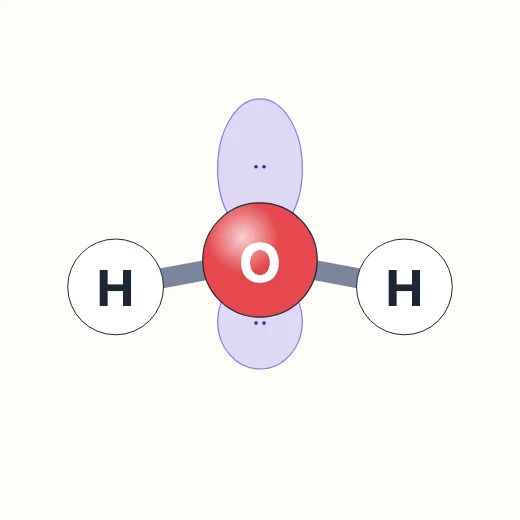
The chlorite ion is shaped like a water molecule with chlorine in the middle: two bonds and two lone pairs on the central atom. The interesting part is the bonding, because chlorine can be drawn either with a plain octet or with an expanded shell.
ClO2− Lewis structure, step by step
- Count valence electrons: Cl (7) + 2 × O (6) + 1 for the 1− charge = 20 electrons.
- Central atom: Cl. Chlorine is the least electronegative atom other than hydrogen (3.16), so it goes in the middle.
- Bond each outer atom to Cl (2 bonds = 4 electrons), then complete the outer atoms (2 × 6 electrons as lone pairs). That uses 16 electrons.
- 20 − 16 = 4 electrons left for Cl: 2 lone pairs.
- Electron domains on Cl: 2 bonded + 2 lone = 4 (steric number). A double or triple bond still counts as one domain.
- AX2E2: tetrahedral electron geometry, bent molecular geometry, sp3 hybridization.
Both drawings are in use. Most general chemistry courses accept the octet form; courses that grade by formal charge expect the second one. Either way the VSEPR count is the same, because a double bond is still one domain.
Shape, bond angle and hybridization
| Property | ClO2− |
|---|---|
| Valence electrons | 20 |
| Central atom | Cl |
| AXE | AX2E2 |
| Electron geometry | tetrahedral |
| Molecular geometry | bent |
| Bond angle | <109.5° |
| Hybridization | sp3 |
| Polarity | Ion (net charge) |
The octet version
Two Cl–O single bonds, two lone pairs on Cl and three on each O give every atom an octet. The formal charges are +1 on chlorine and −1 on each oxygen, adding up to the ion's 1− charge.
The expanded version and its two resonance forms
Making one Cl=O double bond brings chlorine and that oxygen to 0, leaving −1 on the other oxygen only. The double bond can sit on either oxygen, so this view has two resonance forms, with 10 electrons around chlorine. Many textbooks show this lower-formal-charge form, others keep the octet form, and the shape is bent either way.
Bent, like H2O and OF2
Two bonding domains and two lone pairs give a tetrahedral electron arrangement and a bent ion, the same AX2E2 pattern as H2O and OF2. VSEPR puts the O–Cl–O angle a little under 109.5°.
Keep the chlorine oxyanions apart
ClO− (hypochlorite), ClO2− (chlorite), ClO3− (chlorate) and ClO4− (perchlorate) each add one oxygen. Chlorine's lone pairs drop from two in chlorite to one in chlorate to none in perchlorate, so the shapes go from bent to trigonal pyramidal to tetrahedral.
Common mistakes
Watch out
- Using 19 electrons by forgetting the 1− charge; the extra electron makes 20 and gives Cl its second lone pair.
- Mixing up chlorite, ClO2−, with neutral chlorine dioxide, ClO2, which has 19 valence electrons and an unpaired electron.
Practice questions
Try each one before opening the answer.
How many lone pairs does the central Cl have in ClO2−?
Two. After two bonds and three lone pairs on each O (16 electrons), 20 − 16 = 4 electrons are left for Cl.
Give the formal charges in the octet-rule structure of ClO2−.
Cl is +1 (7 − 4 − 2) and each O is −1 (6 − 6 − 1). Together they make the 1− charge.
Why is ClO2− bent rather than linear?
Chlorine has four domains, two bonds and two lone pairs. The lone pairs take two corners of a tetrahedron, so the O–Cl–O atoms cannot line up.
ClO2− compared with similar molecules
| Molecule | Valence e⁻ | AXE | Shape | Bond angle | Polarity |
|---|---|---|---|---|---|
| ClO2− | 20 e⁻ | AX2E2 | bent | <109.5° | ion (net charge) |
| OF2 | 20 e⁻ | AX2E2 | bent | 103° | polar |
| H2O | 8 e⁻ | AX2E2 | bent | 104.5° | polar |
| NO2− | 18 e⁻ | AX2E | bent | ≈ 115° | ion (net charge) |
Where you meet it
Sodium chlorite is used to generate chlorine dioxide for drinking-water treatment and for bleaching paper pulp.
Structure data: OpenStax Chemistry 2e, §7.6 Molecular Structure and Polarity. Shape rules: OpenStax Chemistry 2e §7.6.