The nitrite ion is the anion in sodium nitrite, the salt that keeps cured meats pink and safe to eat. Its Lewis structure needs resonance, because a single drawing cannot show that both N–O bonds are really the same length.
NO2− Lewis structure, step by step
- Count valence electrons: N (5) + 2 × O (6) + 1 for the 1− charge = 18 electrons.
- Central atom: N. Nitrogen is the least electronegative atom other than hydrogen (3.04), so it goes in the middle.
- Bond each outer atom to N (2 bonds = 4 electrons), then complete the outer atoms (2 × 6 electrons as lone pairs). That uses 16 electrons.
- 18 − 16 = 2 electrons left for N: 1 lone pair.
- That leaves N with only 6 electrons, short of an octet. Move one lone pair from the outer atom into the bond: one N=O double bond. Now N has 8.
- Electron domains on N: 2 bonded + 1 lone = 3 (steric number). A double or triple bond still counts as one domain.
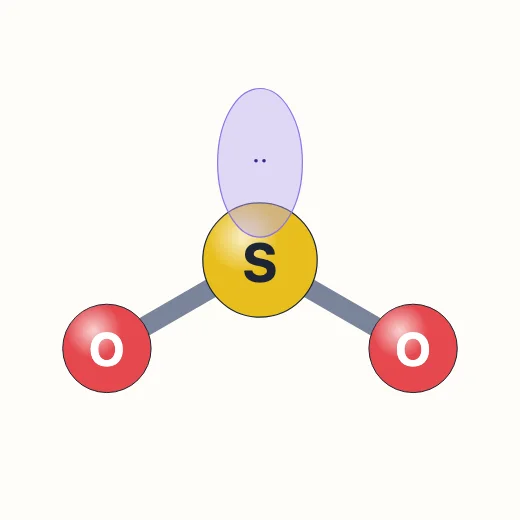
- AX2E: trigonal planar electron geometry, bent molecular geometry, sp2 hybridization.
Shape, bond angle and hybridization
| Property | NO2− |
|---|---|
| Valence electrons | 18 |
| Central atom | N |
| AXE | AX2E |
| Electron geometry | trigonal planar |
| Molecular geometry | bent |
| Bond angle | <120° ideal; ≈ 115° measured |
| Hybridization | sp2 |
| Polarity | Ion (net charge) |
Add one electron for the charge
Nitrogen brings 5 and each oxygen 6, which makes 17; the 1− charge adds one more for 18. After single bonds and full octets on both oxygens, 2 electrons remain for nitrogen as a lone pair, but N still has only 6 electrons. Turning one oxygen lone pair into a second bond fixes that and gives one N=O and one N–O.
Two resonance forms, one real ion
The double bond can sit on either oxygen, so there are two equivalent resonance structures. The real ion is a blend of both: each N–O bond has a bond order of 1.5, the two bonds are equal in length, and the negative charge is shared between the two oxygens.
Why the angle is about 115°
Nitrogen has three domains (two bonds and a lone pair), so the ideal angle would be 120°. The lone pair takes up more room than a bonding pair and squeezes the O–N–O angle to roughly 115°.
Nitrite vs nitrogen dioxide
Neutral NO2 has 17 electrons, so nitrogen carries one unpaired electron instead of a full lone pair. A single electron repels less than a pair, and NO2 opens up to about 134°, much wider than nitrite.
Common mistakes
Watch out
- Forgetting the extra electron from the charge and working with 17; for an anion, add one electron per negative charge, then put square brackets and the charge around the finished drawing.
- Drawing only one structure and saying one bond is double and the other single; show both resonance forms with a double-headed arrow, because the two bonds are actually identical.
Practice questions
Try each one before opening the answer.
What are the formal charges in one resonance form of NO2−?
The double-bonded O is 0 (6 − 4 − 2), the single-bonded O is −1 (6 − 6 − 1) and N is 0 (5 − 2 − 3). They add to −1, matching the ion's charge.
What is the N–O bond order in the nitrite ion?
1.5. Averaging the two resonance forms spreads three bonding pairs over two N–O bonds.
Is the O–N–O angle in NO2− larger or smaller than in NO3−?
Smaller. Nitrate is AX3 with no lone pair on N and a 120° angle, while nitrite's lone pair pushes its two bonds closer, to about 115°.
NO2− compared with similar molecules
| Molecule | Valence e⁻ | AXE | Shape | Bond angle | Polarity |
|---|---|---|---|---|---|
| NO2− | 18 e⁻ | AX2E | bent | ≈ 115° | ion (net charge) |
| NO2 | 17 e⁻ | AX2E | bent | 134.3° | polar |
| O3 | 18 e⁻ | AX2E | bent | 116.8° | polar |
| NO3− | 24 e⁻ | AX3 | trigonal planar | 120° | ion (net charge) |
Where you meet it
Sodium nitrite is added to bacon, ham and hot dogs to block the bacteria that cause botulism and to keep the meat pink.
Shape rules: OpenStax Chemistry 2e §7.6.