Nitrogen trifluoride is a colorless gas used to clean equipment in the electronics industry. It is built just like ammonia, but swapping hydrogen for fluorine shrinks the bond angle and nearly wipes out the dipole.
NF3 Lewis structure, step by step
- Count valence electrons: N (5) + 3 × F (7) = 26 electrons.
- Central atom: N. Nitrogen is the least electronegative atom other than hydrogen (3.04), so it goes in the middle.
- Bond each outer atom to N (3 bonds = 6 electrons), then complete the outer atoms (3 × 6 electrons as lone pairs). That uses 24 electrons.
- 26 − 24 = 2 electrons left for N: 1 lone pair.
- Electron domains on N: 3 bonded + 1 lone = 4 (steric number). A double or triple bond still counts as one domain.
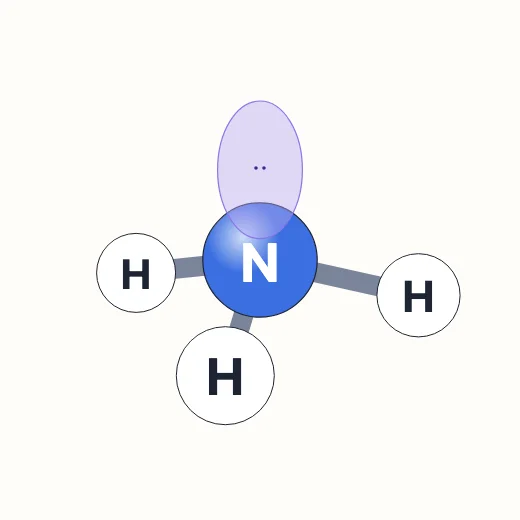
- AX3E: tetrahedral electron geometry, trigonal pyramidal molecular geometry, sp3 hybridization.
Shape, bond angle and hybridization
| Property | NF3 |
|---|---|
| Valence electrons | 26 |
| Central atom | N |
| AXE | AX3E |
| Electron geometry | tetrahedral |
| Molecular geometry | trigonal pyramidal |
| Bond angle | <109.5° ideal; 102.5° measured |
| Hybridization | sp3 |
| Polarity | Polar |
Nitrogen central despite its high electronegativity
Nitrogen (3.04) is quite electronegative, but fluorine is more so and can form only one bond. So nitrogen sits in the middle, keeps one lone pair, and has a regular octet.
102.5° versus ammonia's 107°
Fluorine pulls the bonding electrons out toward itself, away from nitrogen. Bond pairs that sit farther from the centre repel each other less, so the lone pair can push them closer: 102.5° in NF3 compared with about 107° in NH3.
A tiny dipole
NF3's dipole moment is only about 0.23 D, while NH3's is about 1.47 D. In ammonia the N–H dipoles point toward nitrogen, the same way as the lone pair's contribution, so they add. In NF3 the N–F dipoles point out toward fluorine, against the lone pair, so the two largely cancel.
A lone pair that won't share
Ammonia is a good base because its lone pair is easy to donate. In NF3 the three fluorines drain electron density from nitrogen, so its lone pair is held tightly and the molecule shows almost no basic behaviour.
Common mistakes
Watch out
- Assuming NF3 is very polar because N–F bonds are polar (ΔEN 0.94); the bond dipoles and the lone pair partly oppose each other, so the net dipole is small, though not zero.
- Calling the shape trigonal planar like BF3; nitrogen has a lone pair that boron lacks, which lifts N out of the plane of the fluorines.
Practice questions
Try each one before opening the answer.
Show the electron count for NF3.
5 + 3 × 7 = 26. The three bonds use 6, the fluorine lone pairs use 18, and the final 2 form nitrogen's lone pair.
N–F bonds are more polar than N–H bonds, so why is the dipole of NF3 smaller than that of NH3?
In NH3 the bond dipoles point toward N and reinforce the lone pair's effect. In NF3 they point toward the F atoms, against the lone pair, so the two contributions mostly cancel.
What is the hybridization of nitrogen in NF3, and what is its electron geometry?
sp3, with a tetrahedral electron geometry from four domains: three bonds and one lone pair.
NF3 compared with similar molecules
| Molecule | Valence e⁻ | AXE | Shape | Bond angle | Polarity |
|---|---|---|---|---|---|
| NF3 | 26 e⁻ | AX3E | trigonal pyramidal | 102.5° | polar |
| NH3 | 8 e⁻ | AX3E | trigonal pyramidal | 106.7° | polar |
| PCl3 | 26 e⁻ | AX3E | trigonal pyramidal | 100.3° | polar |
| BF3 | 24 e⁻ | AX3 | trigonal planar | 120° | nonpolar |
Where you meet it
Chip makers use NF3 to clean the chambers that deposit thin films on silicon wafers, and it is tracked as a long-lived greenhouse gas.
Shape rules: OpenStax Chemistry 2e §7.6.