Phosphorus trichloride is a colorless, fuming liquid that reacts violently with water. Its Lewis structure looks like ammonia's with bigger atoms, yet its bond angle is noticeably tighter.
PCl3 Lewis structure, step by step
- Count valence electrons: P (5) + 3 × Cl (7) = 26 electrons.
- Central atom: P. Phosphorus is the least electronegative atom other than hydrogen (2.19), so it goes in the middle.
- Bond each outer atom to P (3 bonds = 6 electrons), then complete the outer atoms (3 × 6 electrons as lone pairs). That uses 24 electrons.
- 26 − 24 = 2 electrons left for P: 1 lone pair.
- Electron domains on P: 3 bonded + 1 lone = 4 (steric number). A double or triple bond still counts as one domain.
- AX3E: tetrahedral electron geometry, trigonal pyramidal molecular geometry, sp3 hybridization.
Shape, bond angle and hybridization
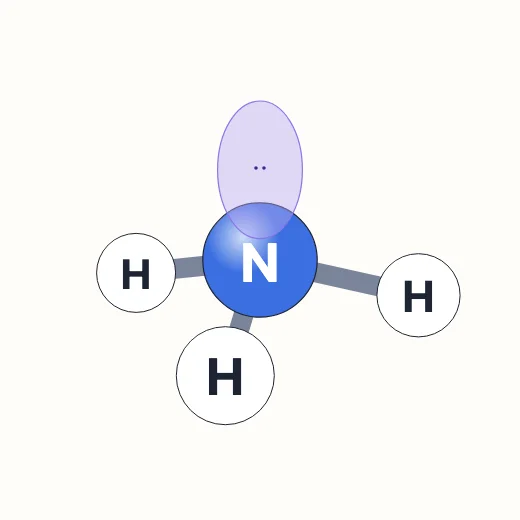
| Property | PCl3 |
|---|---|
| Valence electrons | 26 |
| Central atom | P |
| AXE | AX3E |
| Electron geometry | tetrahedral |
| Molecular geometry | trigonal pyramidal |
| Bond angle | <109.5° ideal; 100.3° measured |
| Hybridization | sp3 |
| Polarity | Polar |
An octet, not an expanded one
Three bonds and one lone pair give phosphorus exactly 8 electrons, so PCl3 follows the octet rule even though phosphorus is able to expand. Compare PCl5, where all five of phosphorus's valence electrons go into bonds and P ends up with 10.
Why 100.3° and not 107° like NH3
Phosphorus is bigger and less electronegative than nitrogen, so its bonding pairs are drawn toward the chlorines and spread around a larger atom. They repel each other less, and the lone pair compresses the Cl–P–Cl angle to 100.3°.
The lone pair makes it a Lewis base
The lone pair on phosphorus can be donated to metal atoms and other electron-poor species, so PCl3 can act as a ligand. The same lone pair is where chlorine or oxygen attaches when PCl3 is turned into PCl5 or POCl3.
Polar because the pyramid has a top
The three P–Cl bonds (ΔEN 0.97) all lean down toward the base of the pyramid, so they cannot cancel. With the lone pair on top and no bond to balance it, the molecule has a net dipole.
Common mistakes
Watch out
- Calling the shape tetrahedral; the electron geometry is tetrahedral, but the shape is named from the atoms only, which gives a trigonal pyramid.
- Leaving the lone pair off phosphorus; 26 − 24 leaves 2 electrons, and without them P would have only 6.
Practice questions
Try each one before opening the answer.
How many valence electrons does PCl3 have, and how are they used?
5 + 3 × 7 = 26: 6 in the three bonds, 18 as lone pairs on the chlorines, and 2 as the lone pair on phosphorus.
PCl3 and PCl5 both contain only P and Cl. Which one is polar?
Only PCl3. Its lone pair makes an unsymmetrical pyramid, while PCl5 has no lone pair and a symmetric trigonal bipyramid.
What hybridization fits phosphorus in PCl3?
sp3, since three bonds and one lone pair make four electron domains.
PCl3 compared with similar molecules
| Molecule | Valence e⁻ | AXE | Shape | Bond angle | Polarity |
|---|---|---|---|---|---|
| PCl3 | 26 e⁻ | AX3E | trigonal pyramidal | 100.3° | polar |
| NH3 | 8 e⁻ | AX3E | trigonal pyramidal | 106.7° | polar |
| PH3 | 8 e⁻ | AX3E | trigonal pyramidal | 93.5° | polar |
| PCl5 | 40 e⁻ | AX5 | trigonal bipyramidal | 90°, 120° | nonpolar |
Where you meet it
PCl3 is a large-scale industrial chemical used to make herbicides, flame retardants and other phosphorus compounds such as POCl3.
Shape rules: OpenStax Chemistry 2e §7.6.