Ozone is three oxygen atoms in a bent chain, and it is the best-known molecule made of a single element that is still polar. It is also a standard first example of resonance.
O3 Lewis structure, step by step
- Count valence electrons: 3 × O (6) = 18 electrons.
- Central atom: O. All atoms are oxygen; one sits in the middle.
- Bond each outer atom to O (2 bonds = 4 electrons), then complete the outer atoms (2 × 6 electrons as lone pairs). That uses 16 electrons.
- 18 − 16 = 2 electrons left for O: 1 lone pair.
- That leaves O with only 6 electrons, short of an octet. Move one lone pair from the outer atom into the bond: one O=O double bond. Now O has 8.
- Electron domains on O: 2 bonded + 1 lone = 3 (steric number). A double or triple bond still counts as one domain.
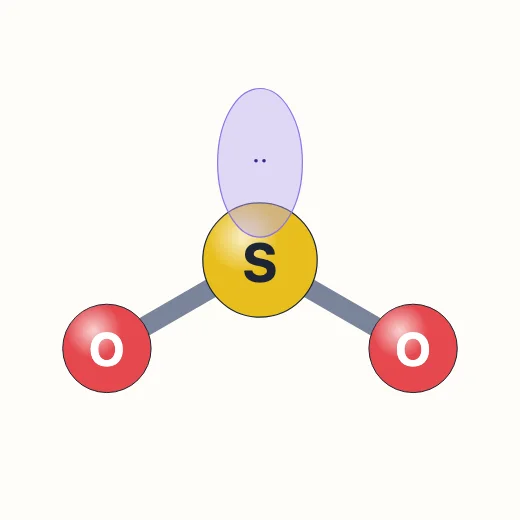
- AX2E: trigonal planar electron geometry, bent molecular geometry, sp2 hybridization.
Shape, bond angle and hybridization
| Property | O3 |
|---|---|
| Valence electrons | 18 |
| Central atom | O |
| AXE | AX2E |
| Electron geometry | trigonal planar |
| Molecular geometry | bent |
| Bond angle | <120° ideal; 116.8° measured |
| Hybridization | sp2 |
| Polarity | Polar |
Two resonance forms, one real molecule
The octet structure has one O=O double bond and one O–O single bond, and the double bond can be on either side. Measurements show both bonds are the same length, between a single and a double bond, so each has a bond order of 1.5.
Formal charges in a one-element molecule
In each resonance form the central oxygen carries a +1 formal charge and the single-bonded end oxygen carries −1. Ozone shows that formal charges can appear even when every atom is the same element.
Bent at 116.8°
The central oxygen has two bonding domains and a lone pair in a trigonal planar arrangement. The lone pair closes the angle to 116.8°, a bit tighter than the roughly 119° of SO2, which has the same 18-electron count.
Polar with nonpolar bonds
Every O–O bond has an electronegativity difference of zero, yet ozone has a small dipole. The central atom is electron-poor compared with the end atoms, and the bent shape keeps that uneven charge from cancelling.
Common mistakes
Watch out
- Drawing a ring of three oxygens or a straight O–O–O line: ozone is an open, bent chain with a lone pair on the central oxygen.
- Calling ozone nonpolar because all its atoms are oxygen: the central atom sits in a different environment from the end atoms, so the bent molecule has a small dipole.
Practice questions
Try each one before opening the answer.
What is the O–O bond order in ozone?
1.5. Each bond is single in one resonance form and double in the other, so the average is one and a half.
Ozone and SO2 both have 18 valence electrons. What do their structures share?
Both are AX2E: a central atom with two bonds and one lone pair, a bent shape, sp2 hybridization and two resonance forms in the octet view.
What are the formal charges in one resonance structure of O3?
The central O is +1, the double-bonded end O is 0 and the single-bonded end O is −1.
O3 compared with similar molecules
| Molecule | Valence e⁻ | AXE | Shape | Bond angle | Polarity |
|---|---|---|---|---|---|
| O3 | 18 e⁻ | AX2E | bent | 116.8° | polar |
| SO2 | 18 e⁻ | AX2E | bent | ≈ 119° | polar |
| NO2− | 18 e⁻ | AX2E | bent | ≈ 115° | ion (net charge) |
| O2 | 12 e⁻ | diatomic | linear | 180° | nonpolar |
Where you meet it
Ozone forms the stratospheric layer that absorbs UV light, but near the ground it is a smog pollutant; you can also smell it after lightning storms.
Shape rules: OpenStax Chemistry 2e §7.6.