Formaldehyde is the simplest aldehyde, a sharp-smelling gas best known dissolved in water as formalin. Its Lewis structure is often the first place students practise turning a lone pair into a double bond.
CH2O Lewis structure, step by step
- Count valence electrons: C (4) + 2 × H (1) + O (6) = 12 electrons.
- Central atom: C. Carbon is the least electronegative atom other than hydrogen (2.55), so it goes in the middle.
- Bond each outer atom to C (3 bonds = 6 electrons), then complete the outer atoms (1 × 6 electrons as lone pairs; hydrogen needs no lone pairs). That uses 12 electrons.
- 12 − 12 = 0 electrons left for C, so it has no lone pairs.
- That leaves C with only 6 electrons, short of an octet. Move one lone pair from the outer atom into the bond: one C=O double bond. Now C has 8.
- Electron domains on C: 3 bonded + 0 lone = 3 (steric number). A double or triple bond still counts as one domain.
- AX3: trigonal planar electron geometry, trigonal planar molecular geometry, sp2 hybridization.
Shape, bond angle and hybridization
| Property | CH2O |
|---|---|
| Valence electrons | 12 |
| Central atom | C |
| AXE | AX3 |
| Electron geometry | trigonal planar |
| Molecular geometry | trigonal planar |
| Bond angle | 120° ideal; H–C–H ≈ 116.5° measured |
| Hybridization | sp2 |
| Polarity | Polar |
Carbon in the middle, not oxygen
Hydrogen can form only one bond, so it is always on the outside. Between carbon and oxygen, carbon is less electronegative (2.55 vs 3.44) and wants four bonds, so it takes the centre, with both H atoms and the O attached to it.
Where the double bond comes from
After two C–H bonds, one C–O bond and three lone pairs on oxygen, all 12 electrons are used, but carbon has only 6. Sharing one oxygen lone pair as a second C–O bond gives C=O, a full octet on carbon, and zero formal charge on every atom.
Why H–C–H is 116.5°, not 120°
Three domains around carbon make a flat triangle, but the domains are not equal. The C=O double bond holds four electrons and repels more strongly than a C–H bond, so it pushes the two hydrogens closer, to about 116.5°, and opens each H–C–O angle to a little over 120°.
Polar because the corners differ
The shape is symmetric, but the outer atoms are not: the C=O bond is strongly polar (ΔEN 0.89) while the C–H bonds are nearly nonpolar. The dipoles do not cancel, and the oxygen end of the molecule carries a partial negative charge.
Common mistakes
Watch out
- Writing all single bonds and stopping when the electrons run out; carbon then has only 6 electrons, so move an oxygen lone pair in to make the C=O double bond.
- Counting the double bond as two domains and predicting a tetrahedral shape; a double bond is one domain, so carbon has three and is trigonal planar.
Practice questions
Try each one before opening the answer.
How many σ bonds and π bonds does CH2O contain?
3 σ (two C–H plus one in the C=O) and 1 π (the second bond of the C=O).
Can formaldehyde form hydrogen bonds with water?
Yes, as an acceptor: water's H atoms are attracted to the lone pairs on formaldehyde's oxygen. Formaldehyde cannot donate hydrogen bonds itself, because its H atoms are bonded to carbon rather than to O, N or F.
What is the hybridization of carbon in CH2O?
sp2. Carbon has three domains (two C–H bonds and the C=O), and its remaining unhybridized p orbital forms the π bond to oxygen.
CH2O compared with similar molecules
| Molecule | Valence e⁻ | AXE | Shape | Bond angle | Polarity |
|---|---|---|---|---|---|
| CH2O | 12 e⁻ | AX3 | trigonal planar | H–C–H ≈ 116.5° | polar |
| COCl2 | 24 e⁻ | AX3 | trigonal planar | 120° | polar |
| CO32− | 24 e⁻ | AX3 | trigonal planar | 120° | ion (net charge) |
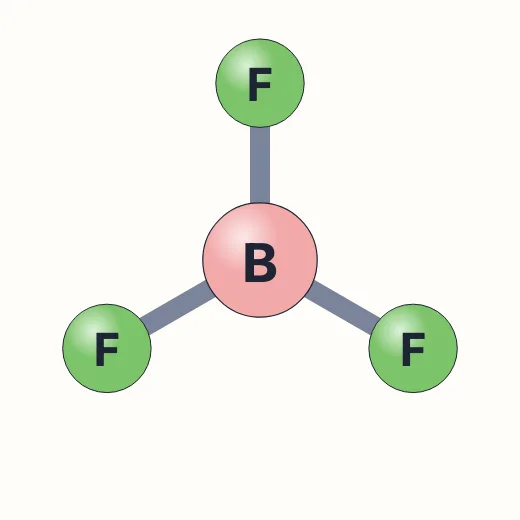
| BF3 | 24 e⁻ | AX3 | trigonal planar | 120° | nonpolar |
Where you meet it
Formalin, a water solution of formaldehyde, preserves biology specimens, and formaldehyde-based resins hold plywood and particleboard together.
Shape rules: OpenStax Chemistry 2e §7.6.