Phosgene has the same 24 valence electrons and four-atom layout as the carbonate ion, but only one good Lewis structure. The double bond belongs to oxygen, and the mix of O and Cl around carbon makes the molecule polar.
COCl2 Lewis structure, step by step
- Count valence electrons: C (4) + O (6) + 2 × Cl (7) = 24 electrons.
- Central atom: C. Carbon is the least electronegative atom other than hydrogen (2.55), so it goes in the middle.
- Bond each outer atom to C (3 bonds = 6 electrons), then complete the outer atoms (3 × 6 electrons as lone pairs). That uses 24 electrons.
- 24 − 24 = 0 electrons left for C, so it has no lone pairs.
- That leaves C with only 6 electrons, short of an octet. Move one lone pair from the outer atom into the bond: one C=O double bond. Now C has 8.
- Electron domains on C: 3 bonded + 0 lone = 3 (steric number). A double or triple bond still counts as one domain.
- AX3: trigonal planar electron geometry, trigonal planar molecular geometry, sp2 hybridization.
Shape, bond angle and hybridization
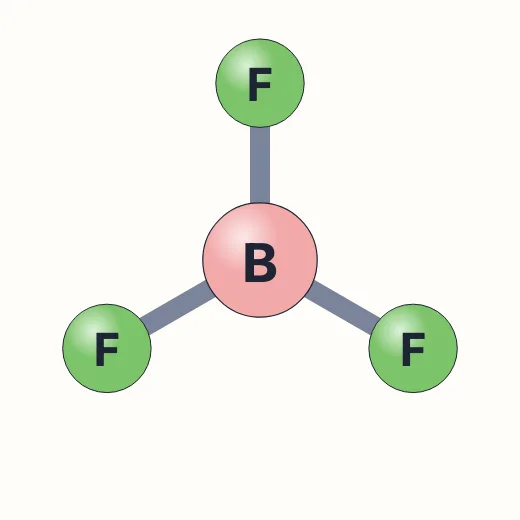
| Property | COCl2 |
|---|---|
| Valence electrons | 24 |
| Central atom | C |
| AXE | AX3 |
| Electron geometry | trigonal planar |
| Molecular geometry | trigonal planar |
| Bond angle | 120° |
| Hybridization | sp2 |
| Polarity | Polar |
Why the double bond goes to oxygen
After single bonds and outer lone pairs, carbon has only six electrons, so one outer atom must share a lone pair. Using oxygen gives every atom a formal charge of 0; using chlorine would put +1 on Cl and −1 on O. So phosgene has one main structure, not three resonance forms as carbonate does.
Angles that miss 120°
The C=O double bond carries more electron density than a single bond and pushes the two C–Cl bonds together. The Cl–C–Cl angle is about 112° and each Cl–C=O angle about 124°, compared with the ideal 120°.
Polar, unlike BCl3
Three identical bonds in a triangle cancel, as in BCl3, but phosgene has one C=O and two C–Cl bonds pulling with different strengths. The leftover dipole lies along the C=O axis.
A chlorinated formaldehyde
Replace both hydrogens of formaldehyde, CH2O, with chlorine and you get phosgene. Both are planar carbonyl compounds with an sp2 carbon and one π bond.
Common mistakes
Watch out
- Drawing three resonance forms by analogy with carbonate; only the structure with the double bond on oxygen has zero formal charges, so it is the one to draw.
- Calling COCl2 nonpolar because it is trigonal planar; the outer atoms are not all the same, so the dipoles do not cancel.
Practice questions
Try each one before opening the answer.
How many σ and π bonds are in COCl2?
Three σ bonds (one C–O and two C–Cl) and one π bond, which is the second half of the C=O double bond.
What is the hybridization of carbon in phosgene?
sp2. Carbon has three electron domains (the double bond counts once) and no lone pair; its unhybridized p orbital forms the π bond to oxygen.
Which bond angle in COCl2 is smaller than 120°, and why?
The Cl–C–Cl angle, about 112°. The electron-rich C=O double bond repels the single bonds more strongly than they repel each other.
COCl2 compared with similar molecules
| Molecule | Valence e⁻ | AXE | Shape | Bond angle | Polarity |
|---|---|---|---|---|---|
| COCl2 | 24 e⁻ | AX3 | trigonal planar | 120° | polar |
| CH2O | 12 e⁻ | AX3 | trigonal planar | H–C–H ≈ 116.5° | polar |
| CO32− | 24 e⁻ | AX3 | trigonal planar | 120° | ion (net charge) |
| BCl3 | 24 e⁻ | AX3 | trigonal planar | 120° | nonpolar |
Where you meet it
Phosgene was a chemical weapon in World War I; today it is made on a large scale to build polycarbonate plastics and the isocyanates behind polyurethane foams.
Structure data: OpenStax Chemistry 2e, §7.6 Molecular Structure and Polarity. Shape rules: OpenStax Chemistry 2e §7.6.